Showing posts with label Auschwitz 2012. Show all posts

Friday, March 16, 2012

Chelsea: The Last Chapter

View of Krakow from the Castle

Grounds of the Wawel Castle

Our adventures in Poland have unfortunately come to an end - but went out with a bang as we spent this beautiful sunny day exploring the city of Krakow. We spent the morning on a four hour tour of the city - focusing on many of the former Jewish areas. We covered a lot of territory. First we visited the former Jewish district of Kazimierz. The remains of Jewish cultural life can be seen nearly everywhere in this region. Though there is no substantial active Jewish population left in Krakow, there still exist Jewish restaurants, old synagogues, and Jewish cemeteries. We saw many of these buildings; some are abandoned, others used now for different purposes, and some open to observe. The Jewish cemetery we saw in Kazimierz was very interesting. One of its walls is composed of old Hebrew headstones - a mosaic of pieced together memories from Krakow's past. We then crossed the Wisla river and stopped at an exhibit called the "Empty Chair" art exhibit. This is an exhibit placed in an barren plaza: all except for a number of empty and plain chairs placed there to symbolize the furniture left behind when the Jews would move to or leave the ghettos as well as to symbolize the absence in the district as a result of the extermination of Jews.

Perhaps my favorite parts of today's time in Krakow was touring the Wawel Castle and spending time in the famous Market Square. Since Krakow is a very old European city its architecture is very ornate and beautiful. The Wawel (pronounced Vavel) Castle is a gorgeous feat of engineering. There is the actual castle, a cathedral, and many other buildings all grouped together atop a hill. As you can see from the picture above, the castle overlooks the whole city and was positioned in this location for defense purposes. The Main Market Square is also quite beautiful - and very large. Apparently, it is the largest medieval town square in Europe. It is surrounded by many beautiful buildings and is quite busy, especially on sunny days like today. In the middle of the square there stands a long building in which there are many stalls for vendors. So of course, I took the opportunity and I stocked up on Polish souvenirs!

We ended the night at the Galicja Jewish Museum, in which we attended a Jewish Shabbat service with Beit Krakow - a small Jewish congregation that is trying to reestablish the Jewish presence in Krakow. I have never been to a Jewish service before. I was expecting to enter into a synagogue and that the service would be very formal, but this particular group was very laid back and young and they worshiped in the museum, which I found to be very interesting. Beit Krakow was very friendly and welcoming and it was intriguing to experience this unique service that was given in a mixture of Hebrew, Polish, and English. After the services, we spent some time visiting with the members of the congregation. As was everyone I came across in Poland, these people were very nice and loved talking with us.

Overall, this week abroad has been a great experience. Though it was jam-packed with many activities and passed by very quickly, I have learned so much, met many great new friends, and now have memories that I am sure will last a lifetime. I wish we had more time here but in a few hours we will be making our journey back to the US. I didn't know what to expect before coming here but I have decided that I like Poland and that hopefully in the future I will return again!

Thursday, March 15, 2012

Chelsea: A Movie Review

The Boy in the Striped Pajamas  - Our attempt to unwind after a long week.


A film is - or should be - more like music than like fiction. It should be a progression of moods and feelings. The theme, what's behind the emotion, the meaning, all that comes later. 
- Stanley Kubrick


I believe in the power of film. It can be a very useful means in conveying a lesson. If done effectively, film can make you feel and make you think. I have heard many good things about the film we watched this evening: The Boy in the Striped Pajamas. Based on the previews, it seemed to be a fitting movie to culminate our visits in Auschwitz. However, it was not what I, nor the rest of the group, expected. 

It was a very emotional film - it was an honest attempt to tug at the audience's heart strings - but it was just not believable. Anyone who has any knowledge about the Holocaust and the Nazi death camps during WWII would realize from the start that the story presented is nowhere near accurate. I realize this is a fictional film, but it is very misleading and does not display much evidence of research in terms of the film's context. Originally we were going to watch the film prior to our visits, but now I am glad that we waited to view it until after because we had the chance to become well informed on the subject whereas the film could have mislead us. I have several issues with the film:

- The plot is completely unbelievable. Something such as this never would have been allowed to happen. Many times, the families of the Nazis were known to share the same ideologies and sometimes to be just as cruel as their perpetrator relatives. It is not likely that the wife of the SS commandant would have been so emotional and opposed to her husband's actions. And usually, the children of the SS were sheltered from the situations of the camps or brought up in such a way as to accept what was happening if they knew of it. 

- As far as historical accuracy is concerned this movie is a complete over-exaggeration. I may even go so far as to call it a severe misrepresentation. The child of the SS officer would not have been allowed near the fence. Most of the barbed wire fences, at least in Auschwitz, were also charged with an electric current. None of the passing of things between the fences would have ever happened. Guards would have also been patrolling the fence. The meetings between the two boys and the entrance of the SS officer's son into the camp are very far-fetched. A boy of eight years would most likely have not been working the camp. The Nazis usually exterminated children not capable of work (younger than teenagers) but if they kept younger children alive, I do not believe that they would be working in the camp as depicted here. The film also depicted prisoners working at the home of the SS officer. I don't believe this would have ever happened either - or at least I have never heard of such a thing. 

The ending was especially ridiculous and very depressing. The film definitely manipulates the emotions of the audience during some scenes, but if you are educated enough to realize the mountain of untruths, the emotion is taken away because it is based upon nothing that really happened. The actual conditions of the camp were not even portrayed as that dismal. If anything, I believe that this film trivialized the atrocities committed by the Nazis during the Holocaust. The end did not depict the death or the plight of the prisoners in the camp, rather the mother of the main character- the wife of the SS - crying over the loss of her son. Are we to feel sympathy for the perpetrator? I could not take this film seriously; it was unfortunate. The only redeeming quality of the film is perhaps that it acted as a test of our knowledge of the Holocaust as we had to distinguish fact from fiction while watching it. 

For a more cynical review (which I also agree with) please see the following link: 
http://movies.nytimes.com/2008/11/07/movies/07paja.html

Michelle: The Person Living in Broken Glass

Today was spent in the Center listening to wonderful and informative lectures from our professors and even a visiting professor from Auschwitz. Because we did not get out and did not take any photos, I have this photo I took a few days ago at the Jewish cemetery in Wadowice. I knew when I took the picture, I felt something but I wasn't sure what it was. I've had nearly a week to think about this photo and what it meant and how it made me feel. What did that glass symbolize for me, that it has kept me thinking all week? What did I think this glass symbolizes for the people who lived or died in the Holocaust, especially the Jews? So many questions, and I tried to organized them one of the only ways I could: poetry.

The Person Living In the Broken Glass
Why is this glass breaking around me?
It was fragile, but strong.
The world I knew, the world I saw.
It was breaking, but it has to last.
Why is this glass caving in?
It is... leaving me.
The world I knew, the world I believed.
Why is this glass shattering?
The world I knew, the world is cutting me.
Glass sharp like the knife cutting through the fog.
Glass sharp like the names they throw at me.
Glass sharp because there is no more glass to safeguard me.
The pieces fall to the ground, feeling the ground
dirty, wet, but I am still dignified. 
The pieces fall together, feeling for each other
longing, craving, but I am still patient.
Why am I the only one who lives in Broken Glass?
You are warm.
You are fed.
You do not live in Broken Glass.
You do not live in an abandoned life.
You do not wish for one shard of cover.
You do not wish for one piece of bread.
You do not wish for one shred of hope.
It was fragile, but strong.
Oh, strength! Why have you abandoned me?
Oh, life! Oh, death!
Choose for me, whether or not I am destined
to the life in the Broken Glass.

Wednesday, March 14, 2012

Chelsea: Auschwitz - The Ultimate Haunted House

Self Portrait of Holocaust Survivor and Artist Marian Kolodziej (left is his prisoner identity, right is him after the war)

The Layout of the Exhibit

"Sometimes I can't help but feel helpless
I'm havin' daymares in daytime
Wide awake try to relate
This can't be happenin' like I'm in a dream while I'm walkin'

Cause what I'm seein' is haunting
Human beings like ghost and zombies.."

 -From "Road to Zion" by Damian Marley and Nas

Today I saw many ghosts. They were in the rooms, the walkways, the walls, and on paper. We can see them before us - wandering and lost. Shadows of a time long past, but still living in the minds of the survivors. Can you imagine? Each day continues to shock me. The quote I have mentioned above reminds me of this morning's experience. We visited an unique art exhibition displayed in the basement of a church in the nearby town of Harmeze. There are simply no words to speak that will do justice to the art produced here. The pictures (shown above) were created by Holocaust survivor Marian Kolodziej. The pictures of his memories that he created are amazing in and of themselves, but there is an even more shocking element to his work. He created all of the work in the exhibit - which is enormous - while recuperating from a stroke. It was incomprehensible. It was said that he would not speak of his experiences in the camp. It took 50 years for him to release his emotions and memories and he did so through these detailed and grotesque drawings. Virtually all of the drawings show the distorted faces and bodies of those in the camp, looking more like aliens from a sci-fi comic than representations of human beings. The art was admirable in its talent and a clear expression of the pain the artist must have felt from his experiences. It was his way to make sense of the illogical and to escape, if only momentarily, the ghosts of his haunting past.

The ghosts followed us throughout the day as the memories and testimonies stuck with us. In the afternoon we returned to Auschwitz I to walk through more of the exhibits. The first block we returned to displayed an exhibition of the genocide against the Roma and Sinti people (the "gypsies"). We did not have to much time to go through the exhibit and while we were inside, the lights were shut off. It was a truly scary experience, yet you could call it "authentic." It gave us an idea - if only in the slightest - of what it may have been like to be in the camp during its operation. Another particularly chilling exhibition was that of the French victims of the Holocaust. The exhibit was set up to simulate shadows of the victims on the walls of the dimly lit room. The sight literally gave me chills. It was a very blunt and sober reminder of the lives lost at the hands of the Nazis. Every corner you turned you would feel as if you were being watched or followed by these painted on shadow simulations. It was a very powerful display. Though these experiences pale in comparison to the reality of Auschwitz, it is these small reminders that keep the Holocaust with us in our memories. It brings to mind the grim reality and history of the place: the fact that millions suffered and died here, though you can see that no more. For me this is the true definition of a haunted house.

 "Do you not see how necessary a world of pains and troubles is to school an intelligence and make it a soul?" 
- John Keats

But as I mentioned in yesterday's post, there may be positive aspects to all of this senseless suffering. From the ruins of Auschwitz and other locations in which the Nazi's perpetrated their evils there can come many beautiful things. As I have shown you today, art is one of these results. Drawings, memoirs, poetry - all ways of coping with the past that will last eternally as ink on paper to bear witness to the extremes of human cruelty. Perhaps it is these methods of coping, these responses to suffering that help to make us more human in the end. Counteract inhumanity and depravity with the utmost examples of humanity. After spending three days in the Auschwitz camps my mind is reeling with information, images, thoughts, questions. Three days and there is still so much more to learn - we have only brushed the surface. Three days and I still have not been able to sort through the overwhelming influx of history that was thrown at me in the camps. I am still digesting. But if there is anything I have learned so far from my experiences in the past few days it is that we must bear witness to the Holocaust. I have heard this lesson time and time again, but it becomes even more important the more time I spend here on this tainted land. As the young generation, as students, as visitors to the camp we must carry on the testimony as the survivors pass on. I truly hope that this era in history will never be forgotten, because there is so much to learn from the atrocities that happened here.

Michelle: Art and Shadows

Drawing in Marian Kolodziej's Labyrinth,  a testimony to his five years in Auschwitz.
This morning we went to the art exhibition of a very interesting man, Marian Kolodziej. He spent five years in the camps, primarily Auschwitz, which is phenomenal when most sent there only lasted weeks or months. He was number 432. After Liberation, he did not speak of his time there for over 40 years. He then had a stroke, and was finally compelled to give the world a piece, just a slice, of what he felt in the camp. He used the art as a way to heal from the stroke, and give testimony of his life during the Holocaust.

Another drawing: depicting the longing eyes of prisoners.
Many of his drawings were intriguing in the macabre, full of symbolic images and detailed drawings of people he remembered purely from memory. What astonished me was that he designed the exhibit himself! Well, I shouldn't really call it an exhibit. He didn't. Instead he said:

"This is not an exhibit, nor art, nor images, but words contained in designs."

His words are as powerful, even after his death, than 'real' words. Staring at the pen-strokes I got chills, feeling the pain he did when his hand pressed against the paper. Intricate shadows and lines made every picture worth looking at for many minutes at a time. However, we did not get as much time as I would have wanted there. I tried to take pictures of everything, in order to feel and experience more of his feelings.

Later, we went back to Auschwitz unguided. The five of us went to the exhibitions for the Roma, Austrians, Slovaks, and French. We actually got the lights shut off on us in the Roma exhibition, since it was closing time! Besides that frightening experience, all four exhibitions were extremely interesting. It was weird to see each perspective because sometimes they differed in their memories of histories. Between the four though, my favorite was the French. It was so interesting because they had a room a white lighted panels dedicated to specific numbers of transported and murdered victims. Also, it had shadows on the wall to represent mysterious victims. While it was incredibly creepy, it really added to the feeling of not really walking alone through Auschwitz, even if you are alone.

Appearance of shadow in French exhibition
And so I said goodbye to the grounds of Auschwitz for the trip, although it is consistently going to stay with me in words, actions, and dreams. The emptiness is going to continue to shatter through every thought I have from now on, with violent reason and clarity.


Tuesday, March 13, 2012

Michelle: Among the Lost


I am the way into the city of woe, 
I am the way into the eternal pain,
I am the way to go among the lost.

'Per me si va ne la citta dolente, 
Per me si va ne l'etterno dolore,
Per me si va tra la perduta gente.

- Canto 3, Dante's Divine Comedy

On the syllabus for this course, one of our trip's guides, Dr. Procario-Foley, pointed out a quote from a Jewish philosopher, Emil Fackenheim. He says, "Auschwitz is a unique descent into hell". Today in Auschwitz-Birkenau I found myself asking questions about this idea and trying to search for the right things to think or say. When I returned to the Center and stared at my luggage, I found it fascinating that a book I have been reading for another class could say the words I was too deranged to find yesterday in Auschwitz. It could also say the words that could communicate what went through our minds as we walked in the valley of the dead and breathed in the cold and silent air.

But is this place just for the dead? Countless groups of Israeli students and soldiers walked through the camp as well, proudly draped in the blue and white of their flag. Other English speaking groups circled up discussing the ideas of humanity and life. Rocks placed on almost every of the language's plaques at the memorial in the camp are signs that people, regardless of nationality, have some connection to the atrocities of the Holocaust, even almost a century later. 

In the spirit of Dante, the Italian plaque of the memorial
Among the living were us. Among the rememberers were us.

Yesterday, in Auschwitz, I was stifled. It was hard to breathe as everything was so close together. Barrack next to barrack. Fences and gates trapped me. I descended into woe, pain, and the feeling of lost. Senselessness.  I descended into Dante and Fackenhein's hell. Today, however, in Birkenau which is so wide and vast, my senses were allowed to feel out the environment. I was able to see further than the fog, smell more than the forest of towering Birch trees, feel harsher than the jagged rocks of the pathways, taste bitterer than the words I choke on, and finally, hear louder than the sound of silence.

I become a victim to feeling too much, while yesterday I could barely feel. However, when you feel, you have to admit, even the most terrible things. I can admit my fright. I was terrified of being in such a place, filled with such pain and misery. I was terrified of breaking down. I was terrified of what happened there and what type of people must have existed in this world to let that happen. I was terrified of asking What could have stopped this, because that What is a Who, and you're not supposed to ask that, are you?

My fear was in many ways quelled, by images of hope. Dante further describes his hell, as abandoned of all hope. However, Birkenau of today is not abandoned. Candles are lit, wreaths are placed, roses are left. People are coming, and people are remembering. People are consciously making an effort to witness and prevent something like this from ever happening again. People are trying, and people and thinking. They are feeling. Sometimes too much, but enough.

Wall of photographs found in the camps at Liberation

Rose placed on the wall of a destroyed gas chamber

Chelsea: A Day of Remembrance

The foreboding entrance to Auschwitz II - Birkenau

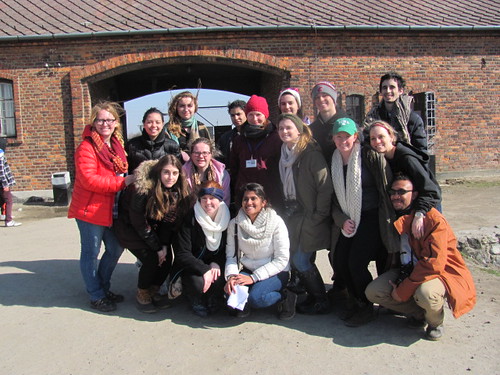
The group and our guide in front of the International Memorial at Birkenau


Having now been to both camps, I realize that what I have seen I cannot translate into words. As the saying goes, you literally have to see it to believe it. I realized immediately upon arrival that Birkenau was a much different place than the Auschwitz I camp we saw yesterday. I do not want to discredit or downplay the seriousness and importance of Auschwitz I, but it just does not have the same atmosphere as its "sister" camp Birkenau. Compared to Birkenau, Auschwitz I looks like a village, a populated, "civilized" (if I may use this word loosely) place. What struck me first at the Birkenau camp is its enormity and desolation. The only image I have previously seen of this camp is of the main building at the entrance (pictured above). This building looms over the entire camp, but although there are other buildings around, the land looks so empty. Emptiness and silence. That is how I characterize Birkenau. Yet as I explained about Auschwitz in my last post, the silence is almost soothing, as ironic as that may seem. The camp is surrounded by forest. There are many birch trees: we were told that Brzezinka (the name of the town that the camp is in/near) is named after these trees, and this word in English is translated to Birkenau. The quiet, the mist, the forest, and the deer (we saw some deer running at the edge of the camp) create a very peaceful atmosphere - quite contradictory to the chaos and violence that occurred here in the past. You think it is peaceful until you remember something : you are standing on the graves of so many people. Ashes from the crematoria were spread in many areas across the camp, and there lie the only remains of the Nazi's victims.

Visiting the camp also brought to my mind many questions. Seeing the map of the camp and its size, and hearing about the planning of such atrocities that occurred in the Nazi camps is perhaps one of the most disturbing aspects of the Holocaust. Killing anyone is bad; genocide in any form is an evil thing. However, when something such as this was so meticulously organized it seems to denote some elevated level of depravity and mental sickness. Also, seeing the camps as a testament to the Holocaust led me to wonder how any person could ever DENY the crimes of the Nazis. There is nothing to deny. The camps are still here, the artifacts are still here, some survivors are still here, we have documents, memoirs, and photographs. There is so much disturbing evidence, yet there are people that continue to deny the existence of this event. I just don't understand, and especially after seeing all of this, such attitudes make me angry.

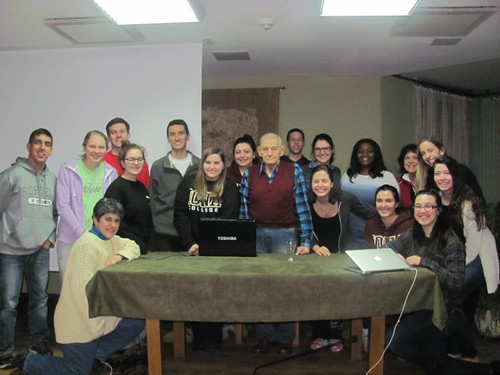
Believe it or not, there were positive outcomes of the Holocaust. Survivors are a great example of this. Today we were fortunate enough to meet a Polish Holocaust survivor: Mr. Krasnokucki. This will be my second opportunity to meet a survivor. It always surprises me to see how happy and optimistic some survivors are. They have been through such difficult times and have faced such persecution and cruelty yet they remain happy people and for the most part have led good lives after the war ended. Mr. Krasnokucki's life seems to have followed a similar pattern. After the war (he was only 20 years old when the war ended) he moved back to Poland and was fortunate enough to meet up again with his surviving brother. He got married and started a family and has lived to see his great-grandchildren. He obtained a PhD and has worked as a chemist. One would think that such a meeting with a survivor would be a sad experience. However, I was able to see the good in the situation and come away admiring the strength and optimism of Mr. Krasnokucki and survivors like him.

Monday, March 12, 2012

Chelsea: Auschwitz and Oswiecim - The Past and The Present

Sign commemorating the gas chambers and crematorium at Auschwitz I

The group and our new Polish friends at PWSZ

So today was the big day of this trip: our first visit to Auschwitz I. The site has literally been staring us in the face since our arrival on Saturday as it is located directly across the street from the Centre. But today we actually stepped foot in the former death camp and spent three and a half hours there on an informative tour. We arrived there at 9am and the "Muzeum Auschwitz" as the memorial site is referred to here, was still quiet with few visitors. Seeing this place - this location with a history of mass murder and human cruelty - in such a peaceful and calm state was very disconcerting at first, but then it helped me to understand another thing that Fr. Manfred had told us last night in preparation for today's visit. He said that though it may seem odd, Auschwitz is now in part a positive place. Though it was created and operated as a horrible death camp, it is now a place that represents healing for many. Visitors go there for a positive reason; to remember what has happened, to memorialize those who have died by the hands of the Nazis, and to make sure that this will not happen again in the future. Though I realized what Fr. Manfred had meant by experiencing this serene morning, the peaceful atmosphere was a stark contrast to the reminders of the Holocaust that we saw in the exhibitions at the museum.

Because of the peaceful start to the morning, the seriousness of the visit did not really hit me until I entered a few certain exhibits. These exhibits seem to stand out as powerful to many visitors of Auschwitz : the rooms filled with artifacts left over from the victims of the camp. In particular, the exhibits with the hair and shoes of victims were very moving. The hair remnants from the shaved victims was a very shocking an emotional sight to see. The hair is different from the other artifacts. It cannot be touched, cleaned, or preserved because according to Jewish tradition it should have been buried along with the bodies. An agreement has been made to continue showing the hair as a testament to the crimes of the Nazis until it disintegrates, when it will then be properly buried. The room full of shoes was equally shocking but on another level. Whereas the hair was disturbing just based on the fact that it was a living remnant of the victims, the shoes were a shocking sight due to their amount. On both sides of a long hallway there were rooms filled with mountains of shoes - and we were told that these were not even ALL of the shoes left behind. These two rooms were a very shocking reminder of what really happened at Auschwitz. Another powerful testament to the crimes of the Nazis at Auschwitz were the gas chamber and crematorium (sign pictured above). We were not told by the guide that we were walking into this building, but it was easy to figure out once we were inside. It was a disturbing experience to actually be inside the building in which so many people were murdered. There were many people walking through at the same time as our group and the crowded feel helped us to understand in the slightest bit what it must have been like to be inside that fateful building. It was very uncomfortable being there, both physically and mentally.

Later in the day we ended with a more positive and less heavy experience of meeting with some local Polish college students at PWSZ (don't ask me to write out the whole name of the school, it is too difficult for me to even attempt to say!), a college down the street from the Centre. For a few hours we sat in a seminar with about a dozen English speaking Polish students and their professor (all of us pictured above). It was very interesting to get the Polish perspective on the issues that we are currently studying. After the lecture their group of students and ours went to a local restaurant to talk and get to know each other. They were all very nice and it was a great experience to meet with local Poles our age and get a glimpse of their culture. So though the day began as a tough one with very heavy subject matter, it ended on a happy note as we came away from our day with some new Polish friends from the Oswiecim area!

Michelle: In Auschwitz

The infamous sign leading us into Auschwitz, which in English says "Work will set you free".
Well, here is the bread and butter of our trip... why we are here in Poland, and a big part of what we are studying. I knew that and I sort of had in my mind what I was to expect... I knew it was going to be hard, painful, etcetera...etcetera. You know, I felt I was trained my entire life to see certain images or feel certain things... but it is so different... and much more than you could imagine. So many emotions sort of go through you and make you feel sad, angry, even betrayed. These are emotions they don't tell you that you can feel, you know?

That probably sounds incredibly vague, and I usually can find the right words to describe things, but when it comes to this is almost impossible. Instead, let me try to speak with pictures.

So-called "firing wall" for killing prisoners
View of blocks, most of which hold archives and exhibits now.
The weather was too perfect for the tour, misty and swampy, adding to the swell of emotions, and I can safely speak for the group that it was not what we expected. It became personal as our amazing tour guide slowly walked us through the camp, explaining things with numerous facts and figures that would not seem real without the exhibits. Thousands of glasses stolen from prisoners, suitcases, pots and pans, shoes, and, the worst of all, hair. The worst part of it all was that these were only exhibits. The archives, however, have many more of the same things. I used the word personal because it proved that such a thing was possible, anywhere and anyway. Born in a different time, anyone could have been a victim of such inhumanity. We could have been victims.

Because we are going to Birkenau tomorrow, I know I will probably have more self-reflection, so I will try to end on a happy and positive note. We got to meet up with Polish college students around the area of the Centre. They're really interesting, because they shared their different perspectives. We talked for a couple of hours about varying opinions on everything from Polish-Jewish relationships to even technology and schooling. We then exchanged Facebooks and Tumblrs and the like. I am excited to speak with them more! Today has so far been the most educational day, both in the camp and in the college.

Orly Shachar: A Letter to a Child No More

Natasha Kisler Shachar. Born in 1931. In Auschwitz 1944.

A letter to Natasha Kisler Shachar:

Dear Natasha:

Today, I brought you back with me to Auschwitz, a place you didn’t want to ever see again. The journey is not finished, I said, and you looked the other way. It looks the same and it feels as bad, you said, and I looked right past you. The light, so gray and pitiful, washed the country side with so much pain. The barb wire fence cut through the landscape with so much hate. The rain, these little misty drops of misery, covered everything with a thick layer of hurt.  Did you see the sun when you were here? Did you look around for spring in the midst of a perpetual winter?  You were only a child, beautiful and proud, when you arrived at the end of the world.  You looked up and saw nothing.  No love, no mercy, not even pity. The sun came down and then it disappeared.  Others thought it would come up again but you knew better.  There was no sun in your face, only a vast and cold emptiness of despair. Once you were a happy child, a loved child, a beautiful child.  Was this the end of your happiness? Did you see the tattered love before you?  Did you ever feel beautiful again?

Today, I am asking you, dear Natasha, to let me understand. My feet touch the ground you walked on.  My shoes leave marks where your toes dug in the soil. I see the horror and hear your cry.  Please stop, dear Natasha, stay put and explain. How?  Why? Just say.  Did you pretend it all away?  How did you manage?  Did you know then what I see today?
Today, I claim you, dear Natasha. Hold my hand and I will lead you out. Let me tell you what you are yearning to hear.  This terror will end. You will live again.  Look at me and see your son.  Wipe your tears and see your grandchildren.  We are all in you, beside you, ahead of you.  We will get you through it, calm you and encourage you. We will build you a home, give you a family and grant you much love. You are not alone.

Today, I pray for you, dear Natasha. A child of Auschwitz is only a flower waiting for the rain.  May your heart be filled with faith and patience. May the sun rest upon your face again. May love heal your wound and may peace nestle in your arms. Hope, Dear Natasha, hope hard and strong.
So, now it is time, Dear Natasha, it is time to leave this place. Hear the silence and cry no more. Find your way out and give us life.  Take your place among the living and know you won.  You looked the devil in the eye and he is no more.  You are free and we are you.

 Always,
Orly Shachar

Stembridge Maimbo: If we do not remember

the quotation beside me stayed with me all through the day. walking on the grounds of Auswitz 1 was not easy. i must confess that it raised more questions in me than answers. as our tour guide was taking us round in variuos buildings where people who had different views from Nazis were kept, it was a sobering experience. I can't imagine how a normal person can do such horrible things to another person.
the exibition with hair that was cut from women's head after killing them made me cry. how do you do such a thing? the doctors carrying out experiment on gentics and reproduction on human beings. it is unimaginable. the rooms were cold. there was only one block i remember that had heating system. thats where the SS people were working from. as you can see my picture, i had a few extra layers because the place was wet and cold and later in the evening it was foggy. imagine the people that were kept there as prisoners who had no priviledge like me to wear extra layers. it was inhuman.
it was a time for me to re-evaluate what I hold dear in my heart. re-examining the values in life and my identity. who am I and how do I relate to other beings? Nazis used bioracial to try and exterminate the other race because they wanted a pure race. since you couldn't be here to feel the way I am feeling, I ask you to think of what could be done today to avoid a repeat of what happened at Auswitz. I learnt that it was not only the Polish Jews that were in these camps but also Polish, Gypyies, French, Russians, Hungarians and so on, that means, anyone in the world could have had come here.
i leave you with this quotation again from the camp. "We were also human beings." this was what is written at the end towards the crematorium.
i had a humbling experience.

Sunday, March 11, 2012

Michelle: The Rainy Day That Could

Polish sunset, in Oswiecim
I think that picture of the beautiful sun is a fitting start to a blog about the day that itself started with disgusting rain. This morning was murky, to say the least, but getting out really cured it. Our first stop was Wadowice, the hometown of the Holy Father John Paul II.

Such a small and quaint place, it felt so unassuming in the morning. However, the church was the focal point of the huge square and I was amazed by how... well... for lack of a better phrase, "un-quaint" it was. On the contrary to its surroundings, it was absolutely beautiful, intricate, and detailed. I could probably fill up this blog with hundreds of pictures of the interior and exterior of the place. I easily see how the atmosphere could have inspired the Pope.

Pope John Paul II's home parish church
We went to the 12:00 mass, and it was actually a children's mass for young ones preparing for their first communion. They were incredibly adorable, and even if I couldn't understand a word of their Polish, it was nice seeing them so into the idea of mass and learning about religion. We also went to a temporary Pope John Paul II exhibit since the one in his old home is being renovated. The building that held this exhibit actually had in it a stage where young John Paul, known then as Karol Wojtyla, used to act in plays.

A recreation of Karol (left) on stage
Who would have known that the young Pope was an actor? I found this out to be the most interesting part of the exhibit, because it showed him as a person, a relatable person. It reminds me of one of my high school religion teachers. He kept pictures of Pope John Paul II making funny faces on the chalk board so I saw them every day, and I never realized why he did this. Today I saw that there is more to someone than the appearance they are perceived to have. It is important to recognize and embrace this.  Everyone has human qualities, even one of the most outstanding people who ever lived.

My goodness, I talked so much about Wadowice without mentioning the second half of our day, Oswiecim. Oh well, I think I can sum it up in a picture:

The most delicious hot chocolate ever from Oswiecim, Poland
See you all tomorrow and dobranoc!

Chelsea: Our First True Polish Experience

Statue of Pope John Paul II in front of his childhood church in his native town of Wadowice

Headstones in Hebrew at a Jewish cemetery outside Wadowice

Today was our first true day of exploring and learning in Poland. It was a rough morning for me at first as I was battling an upset stomach. I have a weak stomach for travel, but to me it is definitely worth it to risk the minor suffering in return for a once in a life time experience! We began our morning under a gloomy rain but luckily by the end of the day the sun came out and I felt better and the day improved. Our first stop was the town of Wadowice: the former home of Pope John Paul II (pictured above). When we arrived we briefly explored the local market square, which is a fairly quiet and empty place due to some construction. We took a look at the outside of the Pope's native church as well, where we would be attending noon mass later in the day. The next stop was a museum commemorating the life and work of Pope John Paul II. This is a temporary exhibit set up due to continuing renovations on his old home, which will be the new site of the museum. It was very interesting to learn about Pope John Paul II for a number of reasons: he was native to Poland, the only Polish Pope to ever be elected, he was the first non-Italian Pope in over 400 years, and more relevant to this course, he was a key player in the improvement of Christian-Jewish relations. My only regret about the visit to Wadowice was that I was too sick to enjoy the Pope's favorite dessert: Kremowki. 

While most of our time in Wadowice was spent investigating the Catholic part of Polish culture, we spent the rest of the day delving into the Jewish history of the area (yes, history, because unfortunately the Jewish community no longer exists in this part of the country). During our time in Wadowice we drove to the outskirts of town to visit an old Jewish cemetery (pictured above). The cemetery is no longer in use and most of the stones remain from before the war. It is a quiet place on the edge of a river, but a certain presence still lingers. Though the Jewish community is non-existent in that region, evidence of activity are still visible in the cemetery. Polish cemeteries, I have learned, are well-kept, heavily visited, and very colorful. The more active cemeteries are filled with flowers and lamps of all colors and we're told that at night they are lit up. This Jewish cemetery, though for the most part abandoned, even has a few of these lamps proving that they are not completely forgotten.

The latter part of the day we spent in the town center of Oswiecim. We toured a Jewish museum and learned more about the Polish-Jewish community of the past. We saw the remnants of a standing (yet not practicing) synagogue as well as the empty pit that used to hold Oswiecim's Great Synagogue. As was the cemetery visit, this tour was a sobering experience and a reminder of what the country was like before the war, and the heavy absence that rests upon the community today as a result of the Holocaust.

We ended the day with a lecture from Father Manfred, another educator at the Centre. He spoke to us about three different perspectives of WWII and the Holocaust: the Jewish/Israeli perspective, the Polish perspective, and the German perspective. This foundation is vital in understanding the complexity of the dialogue of memory and reconciliation that began after the war. Fr. Manfred is an expert on Auschwitz; he wrote his dissertation on the camp's commander. One quote in particular from his lecture stood out to me. Speaking of Auschwitz, which is literally across the street from our accommodations, he said, "Everything is difficult here. The past is far away and the most important things are no longer here anymore and must be imagined." This statement helped to mentally prepare me for tomorrow, which will be our first visit to Auschwitz. It is a reminder that Auschwitz is not only a horrible reminder of human cruelty, but it is an engaging place; it provides the location, the context of history, but it is OUR responsibility to place our minds in the past and try to empathize with and better understand the suffering that faced victims of the Holocaust. And with this in mind I prepare myself for the long and heavy day that is before me.

Saturday, March 10, 2012

Michelle: Silence and the Lack Thereof

Driving into the Center for Dialogue and Prayer in Oswiecim.
Hi again, everyone... and now the real blogging begins since I am actually IN Poland. However, wow, that plane ride sure did take a toll on me. Trying to formulate my words into anything but, "I'm in Poland, oh my gosh!" is very hard, but I'll give it a shot.

Before I say anything though, I want to point out that the picture of the sign above was taken a few seconds before we pulled up to the center. We are that close. I knew that we were going to be... but it is surreal when the van pulls up and well... you finally really realize what you are getting yourself into and how much of an impact your experience could have on other people. For instance, every thing I am going to see this week, you're going to see through this blog, my mom is going to see through my words, my friends are going to see through the world of social networking, and my classmates are going to share in the seeing firsthand. My experiences are not just my own.  Maybe I knew this all along, but seeing that sign so close to where I am living this week really sealed the deal that this as more than just a trip and more than just school credit.

We also met with Sr. Mary today, one of the educators at the center. She further prepared us for what to expect. One of the most significant things she said is that we have to be aware of the silence. When we visit Auschwitz later in our trip, we have to acknowledge the sounds of absence, inherently the sounds of silence even if the world around us is noisy. We have to reflect.

If you're anything like me, you look for answers to requests like this in music. When she spoke all I could hear was "The Sound of Silence" by Simon and Garfunkel in my head.

http://www.youtube.com/watch?v=sqGP6p0mNc8&feature=related

Some of the lyrics:

"People talking without speaking
People hearing without listening
People writing songs that voices never share
And no one dared
Disturb the sound of silence"

Can't these verses, taken out of context of what the writers really wanted, almost perfectly describe common reactions to the Holocaust? Silence, repression, and fright. I think they do, but it also praises the alternative, speaking... disturbing that silence. That is what this whole course is about, and really what all teaching should ever attempt to achieve: opinions and conversation. 

Silence must be acknowledged, but it also must be spoken about.

Chelsea: The Long Journey

Preparing for take-off with Air Berlin at JFK on Friday March 9th

Oswiecim (more infamously known by its German name Auschwitz) is where we will be staying and spending much of our time

After many long and grueling hours of travel we have finally made it to Oswiecim, Poland (pronounce it like "Oshviensheem" - that's my best guess at Polish phonetics)! We left JFK airport on the evening of Friday March 9th and after about seven hours of air travel, two hours of poor sleep, and a six hour time difference, we arrived in Berlin, Germany to connect to our flight to Krakow, Poland. The airport was extremely busy and crowded and we had to rush to connect - unfortunately there was no time to purchase any German souvenirs! - but we eventually made it and here I am now, writing you all from Poland!

The forty-five minute drive from Krakow to Oswiecim provided a great opportunity to catch a glimpse of the Polish landscape and culture. We were driven by a local retired policeman named Andre; he does not speak English but is a very kind man nonetheless, and what a lead-foot! I realized that in Poland they drive on the same side of the road as we do in the States, contrary to my previous belief. People also drive REALLY FAST! The landscape is fairly flat in this region with a few hills and a great deal of farmland dotted with small communities. However, Poland is not free from the grips of American commercialism- there is a KFC right down the road in Oswiecim! The architecture here is very interesting; what seems like a stucco exterior often with tile roofing. Some houses are brightly colored and adorned with beautiful glass work and iron fencing, while others are more simple. Either way, it seems like a unique and charming place and I am looking forward to exploring it further.

The drive to the Centre for Dialogue and Prayer in Oswiecim (where we will be staying and learning for the next week) also reminded me of why we are here. Along the route from Krakow to Oswiecim there are many bus stops. I do not speak or read Polish, but I did not need any knowledge of the language to understand what I saw spray-painted on one of these bus stops: a Star of David covered over by a big and threatening X. From our readings and class time in preparation from this trip I have learned that there are still many anti-Semitic feelings present in Poland even after the war, but seeing this with my own eyes really drove the message home.

We had a very warm welcome to the Centre from the reception staff as well as Sister Mary from the Centre's education department. The building itself is absolutely beautiful and provides a peaceful and relaxing environment which I anticipate will help us absorb all that we are about to learn in the next week. We learned a bit about why the Centre is here and what its mission is and were also given a respite from any further work so we could rest as we were all weary from our travels. So far we have had two meals here - lunch and dinner - and both were really delicious. I must admit I was a bit skeptical about whether or not I would enjoy the local cuisine. So the day is finally winding down after many long hours of struggling to stay awake. But may we rest up so that we may continue onward with our journey! Tomorrow it is off to Wadowice (the former home of Pope John Paul II) and the town of Oswiecim.

Thursday, March 8, 2012

Kelsey: The Beginning

Poland group Spring 2012 with Dr. Jolanta Ambrosewicz-Jacobs and Dr. Elena Procario-Foley
Fr. David DeSimone asking Dr. Jolanta Ambrosewicz-Jacobs a question during Q&A
Hello! My name is Kelsey and I’m a Junior, studying Criminal Justice at Iona College. The minute I heard about the Poland study abroad program my freshman year, it had caught my attention. My Grandmother on my Mom’s side was actually born in Poland, and in 1929, when she was only 7 years old she moved to America. Unfortunately, when I was 9 years old, my Grandma had a stroke, paralyzing half her body and causing her to lose her ability to talk. For several years she lived with us, until I was in high school when she passed away. My senior year of high school my family was invited to Poland to attend a wedding for a cousin and get to meet relatives of ours that still lived there. I was able to gain a better perspective of where my Grandma grew up. I had the chance to go for 3 days and I actually stayed in Krakow. When I was on my way to our relative’s house I couldn’t help but notice the smoke towers in the distance and I realized how close they were to Auschwitz. I didn’t have enough time to visit Auschwitz,then so when I found out about the study abroad Poland program, it was the perfect opportunity for me to go back and get to learn about the Holocaust and Poland as well. I wasn’t able to go my sophomore year because I spent the semester studying abroad in Ireland but this year I finally have my chance to go and I couldn’t be more excited. I’m looking forward to learning more about what life was like for Poles living during the time and how it has impacted them. I’m hoping to have a better understanding of the Jewish-Christian relationship, before and after the Holocaust. Also, since my major is criminal justice, I will be interested in learning about the impact of genocide and the crimes that took place in order to learn from the past to help prevent something as horrible as the Holocaust, from happening again in the future. An excellent lecture tonight by Dr. Jolanta Ambroseqicz-Jacobs, from Poland, on “The Holocaust and Coming to Terms with the Past in Post-Communist-Poland” has opened my eyes to the many things I will be learning about this coming week. I will post again when I’m in Poland...Dobranoc :)

Michelle: Let's Go!

Here I am and nice to meet you!
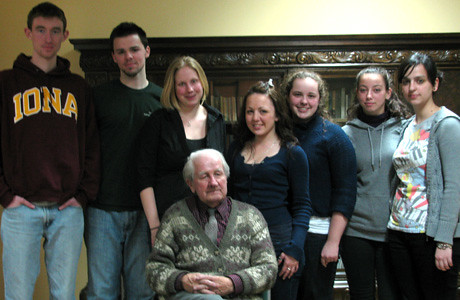
Dr. Jolanta Ambrosewicz-Jacobs from the Center for Holocaust Studies at the
Jagiellonian University in Cracow, Poland

Hi! Or should I say in Polish, "Cześć"? (Don't quote me on that, Google Translate can play tricks on you).  My name is Michelle Muzzio. I am currently a freshmen in the Honors Program at Iona College working on a major in Biochemistry and a minor in Mathematics. I'm leaving tomorrow for Poland, and I need to remember to pack my gloves. It is in the 30's over there! This warm New York winter has me forgetting what real winter is all about.

You may be wondering, like many of my peers did at first, why would a science major want to go on a Study Abroad program focused in the Religious Studies department? Well, the answer lies in my upbringing. I was raised as a mixture of religions. My father's family was Catholic and my mother's was Jewish. While I was baptized Catholic myself, I always wanted to learn more about my mother's heritage, and well... what an opportunity this is! I can complete an upper level Religion course (a requirement for Honors) AND be able to learn something that I have been craving to learn more about since I was little. It is rare that one can take a course that directly targets their life, but gosh, RST 425PO, you hit the target of my life real well.

We have been having classes here in the states for a few weeks now, and tonight was another one of them: a lecture and discussion lead by Dr. Jolanta Ambrosewicz-Jacobs. Through speaking about trends of Polish understanding of the Holocaust, she gave me and the group a very fitting segue into our time together this week. Being in Poland, especially in Oświęcim, we are going to see first hand the Holocaust's effect on Polish culture, of yesterday and today. What I found truly fascinating about her lecture, however, was her use of art and visual imagery to capture the audiences attention. For example...

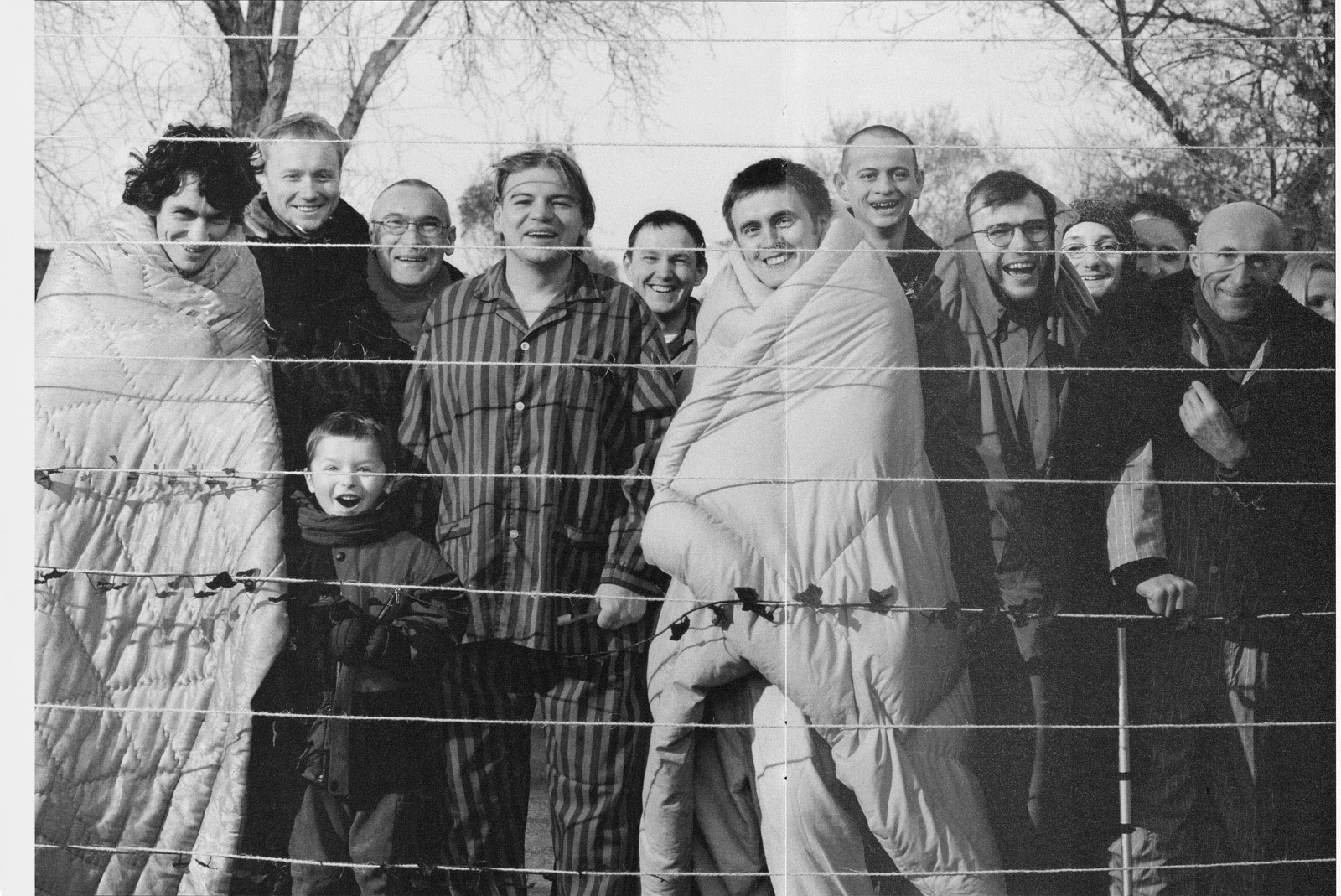
2002, Zbigniew Libera's "Residents"

This is a staged photograph, set many years after the Holocaust, but I realized its relevance when she said something to the effect of: when we see a picture with happy faces like this, we honestly realize how horrible all the rest of the iconic Holocaust pictures are. You must see both in order not to get "used" to what you typically see.

And to be honest, that is exactly what I am expecting to happen on this trip. I want everything I am "used" to hearing or thinking or seeing about the Holocaust or Jewish and Polish tradition to be redefined with the clearer lenses of understanding. I am excited to be able to go home and tell my mom what I learned in school today, and have it not be integral calculus. I'm pretty sure she wants that too.

Also, I am excited for some real Polish food! That can be a reason too, can't it? Here goes nothing, everyone.

Chelsea: A Brief Introduction

This is me: Chelsea Champion!

Jolanta Ambrosewicz-Jacobs (left) and our professor Dr. Procario-Foley (right) during the lecture on the eve of our departure - kicking off our Polish experience!


Hello, everyone! Let me begin by saying that I am glad you are following our trip; I hope that you enjoy keeping an eye on our travels and learning along with us! My name is Chelsea Champion and I am currently a sophomore in the Honors Program here at Iona. I am a double major in Spanish and Sociology with a minor in Peace and Justice Studies. I am from Upstate New York (the Utica area) and this will be my first time experiencing international travel! As the hour of our departure nears I am getting more and more excited!

Though this program and the accompanying class will fulfill one of my graduation requirements, I am not taking it solely for the credits. I see this course - RST 425PO Memory and Reconciliation: The Churches and the Holocaust - as a great learning experience and probably for most people, a once-in-a-lifetime opportunity. My interest in Holocaust studies began in high school. I was fortunate enough to have a great English teacher in both my Junior and Senior years that was fascinated with and well-versed in Holocaust education. So at a fairly young age, I was exposed to the horrors of the Holocaust and the hopefulness of post-Holocaust reconciliation and memorial. I even had the very fortunate experience of meeting a local survivor on more than a few occasions - an experience that is becoming more and more rare as the survivors (a primary source and personal testimony to the atrocities of WWII and the Holocaust) are passing away.

While learning about the Holocaust I have always realized that only those who have witnessed the Holocaust first-hand will ever truly understand what happened. However, through education and dialogue, others can attempt to gain a better understanding of this horrible time in history and learn to empathize with and memorialize the victims. I hope immersing myself in the actual context of what I have been learning about will drive home the fundamental lessons of Holocaust education - that these atrocities really happened, that they must be studied and remembered, and that we must work to be sure that discrimination and genocide will one day cease to exist.

As discussed this evening by Jolanta Ambrosewicz-Jacobs, after being suppressed for decades under a communist government, Poland is finally beginning to come to terms with the Holocaust and is working to construct a collective memory of this time in history and educate the young population in order to subdue and change anti-Semitic attitudes. Though Poland, due to its unique history and circumstances, has had much difficulty in establishing discourse in regard to the Holocaust and still has much room for improvement, other efforts at Holocaust education exist world-wide. I hope to learn a lot from this trip and to come back to the United States and Iona fully able to contribute to this international effort.

Can't wait to leave tomorrow!

Br. Stembridge Maimbo: The Journey Ahead

I am Br Stembridge Maimbo, CFC. I come from Zambia in Africa studying Religious Studies here at Iona College. Coming from a predominant Christian nation, I thought I could use this opportunity to broaden my understanding of the Jewish-Christian relationship. I hope to be enriched by the experience of walking, touching and seeing the actual place and use this knowledge when I get back to Zambia in forming future minds. The course on "Memory and Reconciliation: The Churches and the Holocaust" has motivated me to undertake this Poland trip.

I am looking forward to the trip tomorrow after I good start in tonight's lecture by Dr. Jolanta Ambrosewicz-Jacobs. I have this in mind from today's lecture"Remember the Past, Transform the Future." I am going with an open heart to the challenges of this trip. My concern is how best we could flame an educational curriculum that would help deter a similar event from happening in the future.
I am getting excited. The journey begins tomorrow. I will send you an update. 
Dziekuje