Showing posts with label Kelly Farrell. Show all posts

Sunday, April 2, 2017

Moving On

Auschwitz I- Crematorium
Today is Sunday, April 2nd, 2017 and it has been fifteen days since I have returned from Poland with my classmates. The trip seems as if it was a year ago, but the time has passed so quickly. Reflecting on my time back at school, I am trying to remember daily about the experiences that I had in Poland. When I am stressed over school work or issues with friends, I try and remind myself of what I saw and what the victims of the Shoah went through. I understand that pain should never be compared, however, immersing yourself in the history of the Shoah for a whole week starts to put perspective on events going on in your life. 

I am trying to move on with my life and hold my trip in the back of my mind as a memory and a constant reminder of how bad the victims of the Shoah suffered. However, I must understand that the most important lesson to take away is to never let anything like this happen again; do not be a bystander. We were always taught about being a bystander in grade school. Lessons on how bullying can really hurt someone, but being a bystander could be just as bad was something we were taught from a young age. Learning about the Shoah is no different. The Shoah had its perpetrators, the Nazis, and they were responsible for the suffering of the victims, however, the bystanders, like America, stood there and watched this happen. There are factors that come into play with reasons why America did not step in, for example, America may not have known what was really happening in Poland. Aside from these factors, the bystanders did not help save the victims until most of them died. When thinking about bystanders during the Shoah, I am always brought back to a famous quote by Martin Niemoller: “First they came for the Socialists, and I did not speak out- Because I was not a socialist. Then they came for the Trade Unionists, and I did not speak out- Because I was not a Trade Unionist. Then they came for the Jews, and I did not speak out- Because I was not a Jew. Then they came for me- and there was no one left to speak for me.” This quote has shown up during the course of this semester during my deeper learning of the Shoah. I find this quote so powerful because it sums up the consequences of being a bystander. Not only should you avoid being a bystander for yourself, but for others as well. Stand up for others because it is the just thing to do.

During Dr. Procario-Foley’s lecture on our second day in Poland, she mentioned a quote by Emil Fakenheim. Fakenheim made the 614th Commandment: “Thou shall not grant Hitler a posthumous victory.” I believe this quote sums up everything I am trying to say in this reflection. In order to avoid granting Hitler a posthumous victory, life must go on and we see that in the lives of the victims after the Shoah. Many victims went on to college or remained in the work force. They had families and went back to a “normal” life, even though their experiences were lingering in the back of their minds. I carry Fakenheim’s quote with me, fifteen days post-Poland and I must remember to not grant Hitler a posthumous victory. I must go on with my life after returning from my trip. I must hold in the back of my mind my experiences studying abroad, however, I must take away the important lessons rather than dwell on the past and pity the suffering of the victims. Do not be mistaken, I will hold with me forever the pain and sympathy I felt for the victims. However, I respect the victims for their fight and want to remember this trip as a lesson and reminder during the hate that still occurs in this world today.


Monday, March 20, 2017

Reflecting On Our Trip

Railroad Tracks in Birkenau


I returned from Poland last night and reflecting on the past week is hard to put into words. We were exposed to so many facts, numbers and experiences of the Shoah and to try and formulate and understand in a matter of eight days is almost impossible. Listening to the students that attended the trip last year, I expected to feel a lot more emotional than I did. I was waiting for the big moment when I felt everything that I was experiencing finally come together. I never had that moment on this trip. I believe that maybe one day I will have that moment when I reminisce on my trip, maybe one day it will all come together. However, I am okay with not having that moment. I understand that the trip was very heavy and I am still trying to piece together everything that we learned. I kept trying to put myself in the shoes of the victims of the Shoah and think about how I would have felt during that horrible time. The most important thing I felt during my trip was that the Shoah was horrible and we should mourn the loss of the victims, however, our focus is to never let anything like this happen again. We should not allow history to repeat itself. Keeping that idea in mind, I was able to detach myself from the history and focus on the future.

This past week allows me to reflect on what we have learned in class. I made many connections in my head with the different lectures we have had, writings we have read and videos we have watched. One particular connection I made was with the readings from John Chrysostom’s “Against the Jews”, Homily 1. Chrysostom argues that “I am afraid that, because of their ill-suited association and deep ignorance, some Christians may partake in the Jews’ transgressions; once they have done so, I fear my homilies on these transgressions will be in vain” (Chrysostom, “Against the Jews”, p. 5). The fact that a single person believes that the Jews are awful and their religion is degenerate is sickening. This proves that the targeting of the Jews did not begin with the Shoah. The history of hating Jews begins far back and has not come to a definite end.

Chrysostom’s Homily really hit me when I was thinking about it on our first day in Poland. We visited a Jewish cemetery that had been destroyed previously by Nazis. The defacing of this Jewish property is disgusting and horrifying. To think that people could dishonor the dead by destroying their tombstones is repulsive and unbelievable. We walked around the cemetery and Sister Mary, our guide, told us that the tombstones may not be in the right place because when they were being put back into place, they did not know where the actual bodies lied. It was sad to see a place that people come to mourn for their loved ones, destroyed by the Nazis because of the religion.


Reflecting on this past week gives me a new perspective on the Shoah. Although I did not become emotional during the trip, I was able to take everything in that I was experiencing and appreciate the opportunity I had to travel to Poland and witness firsthand the place that held so much death and destruction. Although most of us learn about the Shoah in school, nothing compares to walking on the very ground that victims of the Shoah walked on over 70 years ago. From here on out, my hatred for the Shoah is even stronger, but my focus is to never let anything like this happen again. I will not let the hate overpower the love.

Sunday, March 19, 2017

Auschwitz II- Birkenau

Rail Car at Auschwitz II- Birkenau
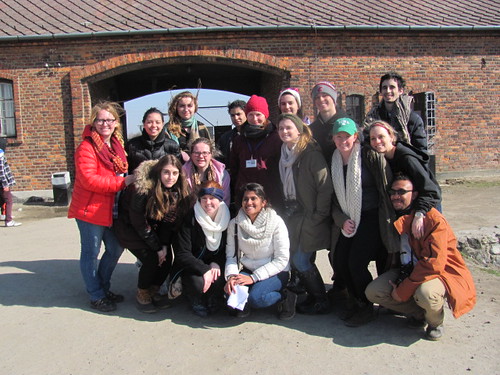
Auschwitz II- Birkenau was planned for 100,000 people. The word planned still rings in my ears. The fact that someone planned to kill innocent people because of what they believe in, where they are from, who they love and many other reasons makes cringe. The size of the camp is astonishing. When we visited Auschwitz I, I did not expect the camp to look the way it did, it was very orderly. Birkenau was what I expected the death camps to look like. The camp was so large, you could not see where it ended. Our first stop was at the main watch tower by the entrance. From the top, we could see almost the entire camp. As we walked along the dirt roads, I tried to imagine the victims walking slowly along the path, with dead eyes that have seen the horror of human capabilities. As we walked through the different buildings, we came across the barracks that were originally made for horses. There were 450 people living in each building. The rings nailed to the wood were still there to tie the horses too. The fact that human beings lived in these conditions like animals still shocks me. The living conditions were horrible, the beds in the women’s and children’s barracks forced 5-6 people to sleep in each bed, which was the size for 1-2 people. The building was cold while we were in there and I could only imagine what it was like for the victims who did not have the scarves, hats and heavy jackets that we did.

Aside from the barracks, we saw the crematoriums as well. Most of them were destroyed during the war, with only rubble left behind. Imagining the victims cleaning out the ashes of their fellow human beings after their bodies were burned horrifies me. I picture my dad cleaning out the fire place of the ashes from newspapers and kindling. Instead, these victims were cleaning out human ashes. Near one of the crematoriums was a small wooded area. Our tour guide, Bart, told us that some of the first victims being led to the crematorium were told to wait there in the woods and that they were just going to be taking showers. The fact that these people were sitting there waiting peacefully for hours without panic because they did not know their fate saddens me because they did not know how brutal the Nazis were until it was too late. This was a moment of peace for them, peace of the unknown.

Seeing the rail cars that transported the victims to the camp struck a sense of sadness in me. I tried to imagine the conditions of the trip for the victims. The fear of the unknown haunting them in a dark, smelly rail car packed with hundreds of people awaiting their fate. The moment the rail car stopped and the doors were unlocked, the victims must have stepped out with gratefulness for the light and fresh air. However, little did they know that their conditions and fate were only going to get worse. Most of us put a stone on the rail cars as a sign of a peace offering.


Reflecting on my experience at Birkenau allows me to connect my experiences with what we have learned inside and outside of the classroom. One learning from class that really connects to my tour of Birkenau is “The Jews & Their Lies” written by Martin Luther. The derogatory stereotypes Luther makes of Jews is expressed in the treatment and stories we heard of the Jews experience at Birkenau. As Father Manfred said in his second lecture, “around 90% of the victims in Auschwitz I and Birkenau were Jews,” this percentage demonstrates that the hatred was mainly towards the Jews. Early writings such as Martin Luther’s work sends the message that the Jews are demonic and hold the Christ-killer charge. Luther writes: “Accordingly, it must and dare not be considered a trifling matter but a most serious one to seek counsel against this and to save our souls from the Jews, that is, from the devil and from eternal death,” calling out the Jews as beings from the devil (Luther, The Jews & Their Lies, p. 21). Luther’s ideas can still be found in present day in the minds of others and were relevant during the Shoah. Reading Luther’s work and then travelling to Poland to tour Birkenau allows me to pull the two together and understand where the hate for the Jews began and the brutality that was inflicted upon them by the Nazis.