Showing posts with label Auschwitz 2017- Christine Kozlow. Show all posts

Monday, May 1, 2017

Never Ending Questions


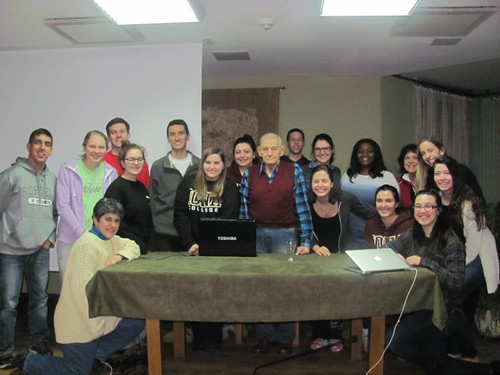
“If you study this subject for 2 weeks all of your questions will be answered, If you study this subject for any longer than 2 weeks, you will never stop questioning”- Dr. Annamaria

This quote Annamaria said in a lecture one evening in Poland resonated with my throughout the rest of our journey as well as everyday since our return. I connect with this quote more than I thought I ever would. Once she said this my mind kind of stopped and I began to relate it to my studies so far. I thought back to the beginning of this class and my time so far in Poland and realized, her words could not be truer. Starting this class I had an abundance of questions but within the first couple of weeks majority of those questions were answered. It was the more in depth we went and the more lectures we heard that my mind wouldn’t stop running and the questions wouldn’t stop generating. I began having concerns about things I never imagined. Immersing myself in Poland and trying to put myself in the shoes of those in the camp is what led to me to generate the questions that I did. What happened to all the women who were pregnant during the time of the transports? Did they carry the baby to full term? Did they deliver in the camp? What about the Nazis; were they all anti-Semitism preachers or did any of them have an ounce of guilt to the thousands of lives they were taking? They just wouldn’t stop and even with being home for over a month the questions still don’t stop. You don’t realize what will hit or what may concern you until you are in that moment, and I think that is why this topic is so difficult to fully comprehend.


When first studying the holocaust you scrape the surface, and may have all your questions answered within that short time of research. It’s when you dig deeper and one question sparks an idea that you look into that leads you to more research and more questions. You’re being exposed to things you may never had known existed and therefore the subject engulfs you and your left with piles and piles of information, but sometimes no answers. Annamaria told us she has been studying for nearly 30 years and is still left with tons of questions.


This just goes to show how deep and intense the Holocaust truly goes. You could study this content for a lifetime and still not fully understand the entirety of it. I am so grateful to be able to comprehend the Shoah on the level at which I do, but I think just like Annamaria, as my studies continue, I will still be left with hundreds of unanswered questions.

Dr. Annamaria 


Sunday, April 30, 2017

The Labyrinth


Through my journey to Poland, I was exposed to more than I could have ever imagined. Hearing stories from those who survived the devastating Shoah, speaking with so many intellectual professors, and exploring art exhibits and museums that vividly explain the agony people endured during this time. One place we visited that truly stuck out to me was The Labyrinths, which is the most vividly illustrated work I have ever seen. 

      This is not an exhibition, nor art. These are not pictures. These are words locked in drawings…I propose a journey by way of this labyrinth marked by the experience of the fabric of death…It is a rendering of honor to all those who have vanished in ashes. (Marian Kolodziej)

Marian Kolodziej, later known as number 432, was one of the first transports to enter Auschwitz. He managed to survive the life in the camp but didn’t speak about his experience until nearly 50 years later. In 1993 he had a serious stroke and as part of his rehabilitation process began drawing, and drew what he was a witness to in the concentration camps. His drawings vividly show the pain, death, and horror he and other prisoners faced. One of the jobs Kolodziej was assigned to work at during his time in the camp was at the crematorium. The heartache associated with being responsible for loading up wheelbarrows with dead bodies to transport to the crematorium is clearly showcased in several of his drawings.


The Labyrinth takes you on a journey of the horrific reality of the holocaust, putting faces to situations you have only read about. You always hear the prisoners of the camps being referred to as “walking skeletons” but these illustrations are what bring that expression to life. To these unfortunate victims so frail and thin while being forced to do such hard labor. In every illustration Kolodziej draws of a prisoner he draws them with large, swollen feet. To me this kind of took me by surprise. Having the prisoners drawn this way is a perfect illustration to show just how overworked these people were. When reading stories about prisoners and the forced labor you understand that they are overworked and tired but you never realize just how much they suffered until you see a picture like that. I recall Sister Mary telling us that the prisoners were only allowed 2 hours of free time on Sunday’s. For the amount of work these people endured 2 hours of free time once a week is nothing to allow their bodies to recuperate. These people are worked so vigorously with little to no food to provide them energy for such tasks, and these illustrations by Marian Kolodziej do a more than perfect job at providing a visual illustration to what these people looked like as a result. 


As you walk around The Labyrinth in random places almost on every turn you see pictures of an eye, always watching you. Seeing a couple at first I figured it was just a coincidence but after seeing several one after the other I figured there had to be a deeper meaning behind this. I asked Sister Mary and she said that the reason for this was because inside the camps there were always eyes watching you. The Nazis were always watching the prisoners to make sure everything remained in the orderly fashion, but it was also to represent one prisoner watching another. Some did it for the sole fact of looking out for one another but others did it because if a prisoner saw something out of character they could report it to the guard and get rewarded. Everyone always had their eyes on you but you didn’t know for what reason. Having just images of eyes watching you was unsettling enough I couldn’t even imagine what it actually must have felt like for the prisoners. They were scared, weak, and afraid and had to watch every move they make. 


The Labyrinth completely opened me up to a new visual perspective of the holocaust I never expected to see. 

Monday, April 24, 2017

Turning History Into A Reality


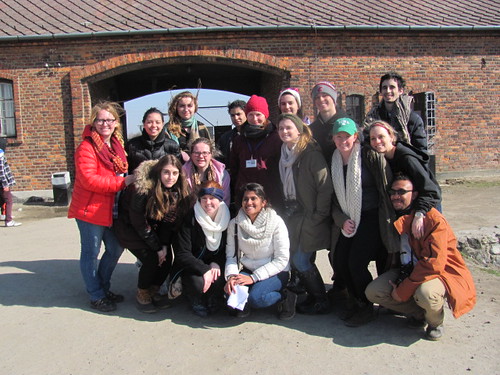
In-between the Blocks at Auschwitz I


The reality of the Holocaust to me is completely indescribable. I had always found this topic captivating because no matter how much I studied, I couldn’t comprehend how this inhumane genocide occurred. When first learning about the Holocaust from a middle school and high school standpoint, you learn almost a “PG” version of what actually occurred. A series of facts and information that is almost sugar coated to a point where you understand just a basic summarization of what happened. It wasn’t until this class and learning about the Holocaust on a collegiate level, as well as actually venturing to a concentration camp, that the shocking truth is unveiled. 

At the start of this class we were assigned to read “The Holocaust Kingdom”, a memoir by Alexander Donat that discussed his experiences before, during, and after the Holocaust. Learning about the Holocaust from a survivor’s standpoint opens up a whole new level of comprehension. You are no longer learning just statistics and facts, but instead learning about someone’s real life experiences. Page after page you’re being exposed to the harsh treatments this person faced every single day, the annihilation of their basic human rights, and the impossible feeling to stay alive for just one more day. By reading this memoir it puts a face to those statistics, turning this piece of history into a reality.

For me, the reality hit even harder once we actually stepped foot on the grounds of Auschwitz. Walking where these people had suffered so immensely can’t help but send chills down your spine. By touring a concentration camp it puts the stories from survivors into perspective. You are no longer imaging the scenario you were once reading about, you are now standing exactly where this tragic moment occurred. You are seeing just how small and cramped these living quarters truly are. You are walking through the gas chamber where you know exactly how many people took their last breath. You are turning facts and stories into a real life experience. You are no longer just an intrigued reader into this subject; you are now a witness to the genocide.

No one can ever be prepared for what they might discover when studying the Holocaust. Studying the facts will introduce you to the subject, but nothing compares to being in the actual spot where these facts arose. Immersing myself further into this subject has generated a whole new level of respect for these survivors and an even greater sorrow for those who lost their lives in this unforgettable tragedy.