Sunday, March 27, 2016

Loving What We Can't Understand

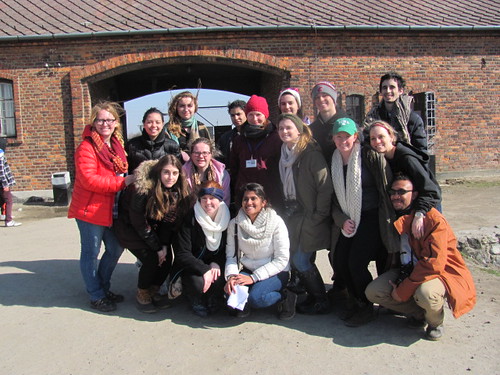
Today we leave Poland.  Visiting this country was an honor and a special privilege that all of us were able to experience.  My perspective of the Holocaust has completely changed throughout the course of 7 days.  At the end of this trip I have realized one thing.  We really will never fully understand what happened during the Holocaust and why it happened.  However, being able to come to Poland and witness the remains the grounds of where it took place has definitely deepened my understanding. My thoughts on what I believed happened during the Holocaust are completely different then what they are now.  I don’t care how many videos, books, and courses somebody has been exposed to.  You learn so much more by physically being here.  There is nothing quite like seeing the streets where once stood ghetto walls, seeing the grounds of the camps, and hearing the stories of survival, hope, and evil. 

One important thing to remember is that you cannot understand the Holocaust without remembering the millions of stories of the lives of each person affected by it.  There are multitudes of individual people that fought for their lives during this time.  You can know that millions of Jewish lives were taken away (over 6 million) but we also have to remember that these are millions of names and stories, not numbers.  Each of these people had lives just like you and me.  College students couldn’t go to school, families were separated from each other, babies were killed for no reason.  Individual lives were completely changed and thrown into one same fate.  Father Manfred told us in his lecture on Thursday that these people were categorized into one stereotype.  However, I will now never forget that each person in life has a name and dignity, you are not just a stereotype. 

The biggest problem of the Holocaust that Father Manfred said that we struggle with is ethics. The question is not where was God, but where was the human being? God is in the dignity of every person.  People encountered God when they decided to recognize or ignore each person’s human value.  Where was the human being to take responsibility and show respect for the life of others? Sometimes people did, and a lot of times, people suppressed their empathy for others.  But why?

In life evil will occur, because evil exists.  Humans have free will, given from God and we can choose to do good or evil.  God does not control this act.  However, we have to learn to love above all else.  To love even what we cannot understand.  I will never understand how the lives of so many people were taken away so efficiently.  However, I do know this.  Love never fails, and though I cannot understand why so much evil in the world happens.  My experience in Poland this week has helped me understand this: despite all our doubts, I need to and will continue to strive to love God and everyone in my life.  Hopefully we will understand, when it is our time, but for now, we are called as Christians to love.  And despite all these questions, I will choose love.


Thank you to Dr. Procario-Foley, Dr. Rozensher, and the rest of my classmates for an experience I will never forget.  I will cherish everything I learned with you and about you!  And to anyone reading this blog, push yourself to be a voice for love in action in the world. 


Friday, March 25, 2016

Faith in the Face of Death

Blog Post 3 - 3/25/16 - Corrine Valenti

      This experience has expanded my knowledge beyond measure and shaped me into a stronger and more compassionate human being. Seeing the horrors of Auschwitz in person, walking the ground where so many perished, is truly indescribable. Walking through the barrack with the remains of human hair encased in glass, torn from the victims upon arrival, was one of the most chilling experiences I have ever had. An intense question I have been faced with this week has been where was God in Auschwitz?

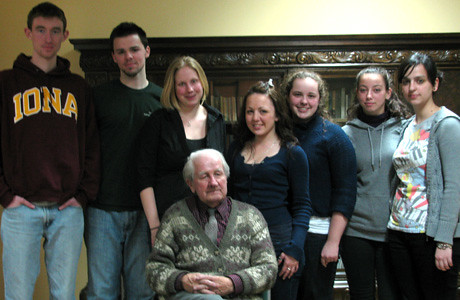
     We have examined this question in a multitude of ways during this week: walking the footsteps of prisoners through Auschwitz I and Auschwitz II-Birkenau, speaking with Mr. Ignacy Krasnokuki a 91-year old Holocaust survivor, visiting the art exhibit of Christian survivor Marian Kociniak, and listening to two powerful lectures by Father Manfred Deselaers and historian Teresa Wontor-Cichy.

     Auschwitz was a place of pure and utter evil however that evil, in my opinion, did not succeed. The goal of the Nazi party, to completely eliminate the Jewish people from existence, was not achieved because Judaism is still alive today as evidenced by the creation of the State of Israel and my group attending a Shabbat service in Kraków on Friday evening. Prisoners showed great deals of bravery, hope, and faith in the camp that I previously thought was impossible. Just to give one example, a group of Sonderkommando, prisoners responsible for emptying the gas chambers and burning the bodies in the crematorium, in Auschwitz II-Birkenau revolted in 1944 and successfully destroyed one of the gas chambers. They were all executed for their bravery and died as martyrs. They found purpose and faith in the face of death.

     Although the evils experienced in the camps were unimaginable, love and faith were never completely lost. Something that was very powerful for me when listening to the story of Mr. Krasnokuki was his discussion of his "camp brothers". Krasnokuki was separated from his parents and two elder brothers during the war, a fate I could only imagine in my worst nightmares. He like so many others faced the Nazi death camps completely alone. He described to us his "camp brothers", a small group of men who he met in the camp who vowed to stick together and help each other survive. "For [we] are all children of God through faith" Galatians 3:26. These strangers, experiencing hell, created a beautiful pact, brothers in every sense of the word; children of God.

     When listening to Father Manfred's final lecture I experienced God's presence in a powerful way. My parents, two of the most incredible people in the world, love me beyond measure. They were extremely nervous about me going on this trip because of the state the world is in right now. However, despite their worries they gave me the freedom to make my own choices and sometimes mistakes. No matter where my choices lead me, even if they are mistakes, I know my parents will be there to guide me through them. This is how I look at my relationship with God. He loves each and every one of His children so much that He granted us the freedom to choose. This all powerful God loves you so much He grants you freedom just like my parents did for me. Unfortunately this freedom comes at a cost. Because we have the ability to choose sometimes our choices hurt others. This happened in Europe during World War II to devastating proportions. God has the power to alleviate all suffering from the world but He entrusts part of that responsibility to His children.

     World War II is a shameful look into the horrors that can happen if we ignore the uniqueness God granted to each person. Labeling people into categories is extremely dangerous and something I plan to stop myself from doing moving forward. We each have a responsibility to creating God's love on Earth because simply saying "never again" is not enough. "Thy will be done on earth as it is in heaven" (Lord's Prayer). I have come to realize through my journey to Auschwitz that the real question is not where was God but where was humanity during the Holocaust?


Wednesday, March 23, 2016

Honoring the Dead: Then and Now

Grave Markers at Jewish Cemetery
Photo by Kristie Botti
During our first few hours in Poland, we had the opportunity to visit the Jewish Cemetery in Oświęcim. After receiving a tour with the most intelligent Sister Mary of the Center for Prayer and Dialogue, our group discovered that many Jewish landmarks of Oświęcim were destroyed during the Nazi reign. One of these landmarks was the Jewish Cemetery in the center of the town. Sister Mary unlocked the gate for our group and we hesitantly wandered inside the gates. This was one of the first major landmarks in Poland that we visited, and anti-Semitism was immediately visible in the dilapidated cemetery. We were informed that after the war, this cemetery was destroyed, and the grave markers were thrown about the plots of land, cracking in the process. As I walked into this cemetery on the first day, I internalized all of the eeriness of nature that was before me. Sister Mary informed us that this cemetery has many unidentified graves, and because of the Holocaust, there is no one alive to take care of them. Only volunteers have been dedicating their time to help beautify the cemetery after a big movement for repair was initialized.

The results of the repaired cemetery are profound. Grave markers are aligned in an orderly fashion within the fenced area. They stand erect as a symbol of strength. It is a fitting symbol in the environment that we have experienced at Auschwitz, giving me the first sense of the strength of the Jewish people here in Poland. It represents the courage and strength that the Jewish population had during this time period in battling adversity and overcoming hardships through restoration.

It seemed symbolic that each erected tombstone was marked with a painted number, like the tattoo numbers on the skin of Jewish prisoners inside concentrations camps. Even in death, each of these people was just a number. Still, these nameless graves were honored with the Jewish custom of placing stones at the site of death, honoring those who lost their lives during the Nazi reign. These were present in various areas in the cemetery that we observed.

Mass Grave Memorial Site at Auschwitz-Birkenau
Photo by Marina Falisi
After visiting the cemetery, I had a similar experience when we took part in a memorial service in Auschwitz-Birkenau at the site of a field that serves as a mass grave. It was here that we were able to honor the lives of those whose bodies and ashes lie beneath the surface of the field. There are no grave markers and no numbers, only a memorial that reads, in several different languages, “To the men, women, and children who fell victim to the Nazi genocide. Here lie their ashes.  May their souls rest in peace.”

It was here that we were able to recite the El Malei Rahamim. Together we prayed, “Exalted compassionate God, grant perfect peace in Your sheltering Presence, among the holy and pure, to the souls of all our brethren, me, women, and children of the House of Israel who were slaughtered and suffocated and burnt to ashes. May their memory endure, inspiring truth and loyalty in our lives. May their souls thus be bound up in the bond of life. May they rest in peace. And let us say: Amen.” Upon the finishing of our prayer service, each Iona student placed a rock on the surface of the memorial markers that are positioned before the mass grave. This was a powerful image displaying the change of attitude towards Jewish resting places.

The graves in both the Jewish cemetery and at Birkenau were unmarked and the result of cruel Nazi rulers. However, even with all the destruction in Birkenau, after all this time, the Jewish people that are buried in the field are resting without a number, with the respect and compassion shown by the visitors of the site.

Hope - March 22, 2016


I found it hard to find hope today. 


Today, we visited Auschwitz II - Birkenau.  This concentration camp is huge, and twenty times larger than Auschwitz I.  Walking around and learning all the facts about the camps was a strange feeling for me.  This place is physically real.  The statistics on how 700 people slept in a barrack at a time, 40,000 people living in the camp at a time, 4-8 people slept on a wooden or concrete bed at a time and many more horrors are all real.  Yet my mind cannot process this.  It does not seem real. 
In the middle of the camp is an infamous ramp.  Families were unloaded off the train wagons and onto the ramp. Women and children were put on one side and men on the other. These families, torn away from each without a proper goodbye, did not know that most likely, they were not ever going to see one another again. 


Train tracks that run through Birkenau


The wagon people were unloaded off

They then waited in-line for the selection process. They did not know that they were waiting to be sent to either the camp to suffer or to the gas chambers to die followed by the crematorium.  One survivor said and I roughly quote that they, “Expected the worst, but did not expect the unbelievable.”  That is where my head is right now at this point.  I take in the facts, but I still just cannot fathom this piece of history.  I cannot emotionally wrap my head around it.  This is a physical place, Birkenau, and we stood today on the grounds of mass execution.
We also visited the gas chambers in the back of the camp.  They are five gas chambers and most of them would hold 1500-2000 people at a time.  I could not help but think of my pops, who was a marine in the 1960s. He told me stories, passed on to him by older marines, about the gas chambers and the Nazis when I was a little child.  He told me that the SS would lie to the Jewish prisoners telling them that they were being sent to take a shower but instead murder them, filling the gas chambers with poisonous air.  This memory flashed back to me today as we learned about the specifics of the process. This story is real. I never really understood the extent of what he was saying until now. The prisoners believed they were taking a shower! They were given a bar of soap and hooks to hang their clothes up in a changing room.  They were lied to up until their final moments of life.  Where was the respect for human dignity?

The gas chamber

We walked through an administration house where hundreds of thousands of previous humans have walked through.  In this building, prisoners where stripped of their clothes, valuables, hair and identities.  They were for now on only referred to as a number with a pair of striped pajamas. 
How did people find hope in this place of ashes, horror, and despair?  While walking through the camp, it started to hail and we became really cold.  It sent me into reality. Prisoners lots of times did the same walk we were doing. Sometimes, they had no clothes nor shoes even.  But they continued.  Where did they find hope?

And then it made sense to me.
Sometimes, you can’t just find hope.  But hope is available for everyone.  Hope is something you have to chose to have. It must have been so hard for these brave men and women.  But they had the courage to believe in something that seemed so far away, a small flicker that maybe they would be saved.  Just maybe they would make it through and see their loved ones again.  Thus, despite all the odds, they had to believe in their human dignity and worth, and carry on.


After it hailed, we held a small memorial service in honor of the the men, women, and children that were lost in that place.  Right after the service, the rain stopped, the sun came out, we heard birds start singing, and church bells rang in the distance.  As we walked down the ramp and out of the camp, I felt a slight sense of peace and yes, hope. Hope can be seen in the little things.  You have to choose to believe in it.