Monday, March 19, 2018

Resistance through Documentation

Resistance to the Nazi regime is a recurring topic when speaking about World War II and the Shoah. The question of whether the Jewish people fought back has appeared several times throughout this course. The answer to this question is yes, the Jewish people resisted. They were not docile lambs led to slaughter. Jewish resistance is evident not only in the texts I’ve read, but also through Jewish people’s actions to their situation under the Nazi regime.

List of Prisoners Found in KL Auschwitz.
This list was found after the liberation of KL Auschwitz. It holds the names and numbers of seven prisoners, and serves as a reminder that they existed. As mentioned in The Holocaust Kingdom, existence in itself was resistance. The Nazis wanted to exterminate the entire Jewish population. By leaving their name behind, the Jewish people were fighting this goal.

There are many different types of resistance that are significant. Besides the obvious opposition through fighting with weapons, the is also forming groups, maintaining culture and religious practices, and the recording of the harsh experiences one suffered. Whether Jewish, another victimized group of people, or an ally, it was so important to preserve the atrocities occurred in the Holocaust.

Alexander Donat also practices this form of resistance in The Holocaust Kingdom. Donat felt a responsibility to survive not only for his family, but also to share all he endured. He kept a detailed account in his notebook of the events as they unfolded. His first-person accounts were crucial to the cultivation of his memoir.

Resistance though the preservation of information was also a prominent theme in The Portraitist. This documentary sheds light on the life of Wilhelm Brasse. A photographer by trade, Brasse was selected to photograph the prisoners in Auschwitz I when he was taken and sent there himself. His photos served as evidence for the sheer amount of people held in the camp as well as the cruel experiences taking place When the Nazis knew they would lose, they began to destroy all proof of the horrors conducted at their hands. Although ordered to destroy the photo documentation, Brasse ensured the preservation of all he had recorded through his camera’s eye. The Nazis could not succeed in covering up their injustices.

The Jewish people were in a threatening situation under the Nazi regime, making it difficult for a mass uprising to physically counterattack their oppressors. These men are three examples of many that found their own ways of resisting those persecuting them from their vulnerable positions. The documentation and preservation of the events that comprise the Shoah creates evidence of its horrors.

The list found of prisoners’ names and numbers instilled in me that not all resistance had to be obvious in order to be effective. This discrete form of fighting back maintained valuable evidence that later held the Nazis accountable. Accountability is vital in the reconciliation of a disastrous tragedy such as the Shoah, making the resistances seen by the prisoners, Donat, and Brasse a key factor in overthrowing the Nazi regime.

Our Duty To Remember

Today is our last full day in Poland. I am filled with emotions as I sit on the bus to Kraków for a long and full last day. As I look out the window, I am reminded of the opportunities that I have been given and how I can use these experiences to advocate and teach others. This week, I have been exposed to many different elements which have left me speechless, yet still I feel the desire to talk about each moment in such detail. The physical aspects of the Auschwitz camps are something that cannot be explained by pictures alone. Many friends and family have been asking what his trip has been like for me and it is impossible to describe my experiences in the short time that we have to talk. When I return to America, I believe it is my duty share the knowledge that I have learned throughout this experience. During one of the first classes we had, Dr. Procario-Foley shared with us the importance of being a witness. After hearing the testimonies of survivors of the Shoah and walking in the footsteps of those who have suffered, I am inspired to continue to share their stories.

Looking out at the immense size of the camp from the watch tower at Auschwitz II – Birkenau.
Upon arrival to Kraków, we visited the JCC (Jewish Community Center), which is a center focused on reviving the Jewish community for all generations. The center started only 10 years ago after Prince Charles visited Poland and spoke with Holocaust survivors about what their needs were, to where they explained that a place of community was needed. The JCC is a great example of how today’s Jewish community can come together a move forward from the destruction caused during World War II. At the center, we heard from a Holocaust survivor named Zofia. I was extremely impacted by her story of survival. She talked about the many obstacles she faced, one which was when her and her family were blackmailed. “Worst moment of my life - we were blackmailed when someone came to my apartment. My mom was terrified. We gave him money, clothes, and whatever else he wanted. After he left, we escaped.” (Zofia, 2018) In class we talked about the many sacrifices that Jews in Poland had to make in order to be kept out of the camps. Zofia admitted she knew she and her family were Jewish, however she was still baptized and learned about the Christian culture so that no one would suggest she was a Jew. Her story concluded with an uplifting quote, “so I am here now, safe, happy and lucky.” This brings me back to what I believe is one of the most important aspects of this trip; it is our duty to remember.
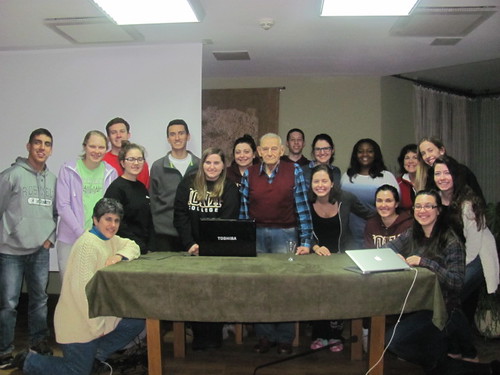
The group posing for a photo with Zofia, a Holocaust survivor after she shared her story.
This theme of remembrance is clearly outlined in not only the Nostra Aetate, but also in the 1998 document written titled We Remember: A Reflection on the Shoah. This document was significant in many ways, one being that it was the first time that the term “Shoah” was used rather than Holocaust. This clearly showed the empathy and growth in the relationships post World War II. Both documents show steps towards moving in the direction of understanding that the murder of 6 million Jews, cannot be forgotten. Whether it be reading and listening to stories or visiting and learning about different sites we have as a group become witnesses to what happened during this dark period in history. I now understand the important of being a witness – it is to share the stories that have been passed down from generations and to share the cold, dreary atmosphere of Auschwitz so people will never doubt, question, or most importantly forget about the Shoah.

I am a witness and I will not forget.

The Execution Wall and the Majdanek Massacre

On March 15th, we returned to Auschwitz I to attend a workshop and explore more of the camp. I decided to revisit the execution wall between Blocks 10 and 11. Most of those executed here were Polish political prisoners, above all the leaders and members of clandestine organizations and people who helped escapees or facilitated contacts with the outside world. Prisoners of other nationalities and ethnic origins, including Jews and Soviet POWs, were also sometimes shot at this wall. The execution wall was dismantled in 1944 on the orders of the camp authorities. Executions were subsequently carried out elsewhere, most often in the gas chambers and crematoria at Auschwitz II – Birkenau. After the war, the execution wall was partially reconstructed by the Museum.

Visiting this wall again reminded me of a scene in Alexander Donat's The Holocaust Kingdom, which can be found on pages 200 and 201 of the text. In this particular scene, an SS officer explains in detail the events of November 3rd, 1943 to the author, in which 18,000 Jews were killed in two days. Why? “Weapons were found hidden among the prisoners. They were going to mutiny!” (Donat, 200). Of course this was nothing more than an excuse and the Majdanek massacre’s true objective was the mass extermination of the Jews located at Majdanek concentration camp and all of its subcamps.

Prior to the massacre, prisoners were forced to dig three ditches that were two yards deep and about 1000 yards long. Male and female prisoners were then driven naked into separate ditches and forced to lie flat before being showered with bullets from automatic rifles. As Donat explains it, “the next groups were forced to lie down on top of the corpses of the previous ones" and “the killings went on for two days, from 6 a.m. to 5 p.m.” (Donat, 201). The killing of all those innocent people struck the author particularly hard, since he thought his wife was among the dead. This scene described in The Holocaust Kingdom may not have occurred at Auschwitz I, where the execution wall is located, but they are indeed connected to each other through a dark and sadistic twist: the irrational hatred of all the Jews of Europe. The murders at the execution wall in Auschwitz I and the scene described in Alexander Donat’s book could have and should have been prevented. It is one thing to read about mass murder in a memoir but when you are standing in a spot where so many innocent lives were wiped out, it brings a new understanding to the cruelty of mankind.

One thing I have learned from this trip is the importance of physicality, for physically being in an area where so many lives were destroyed or forever altered brings a whole new understanding of a situation. In this case, visiting Auschwitz I and seeing a site of mass murder helps me to truly grasp the words written by Alexander Donat in The Holocaust Kingdom.
The Execution Wall at Auschwitz I.

The Eyes are Windows to the Soul

An endless hallway full of photos of the many prisoners of Auschwitz I and Auschwitz II- Birkenau which were mostly taken by Wilhelm Brasse, a Jewish inmate.
Hundreds of faces looking back at me; faces of people who were doctors, engineers, teachers, and many more. Sad, scared, and fearful faces displayed down a never-ending hallway. “How could this be real?,” I thought to myself as I stood in the bunker speechless. How could these human lives have been taken? These are questions I asked myself throughout this entire trip. I gave myself a few minutes to look at these photos and continued my walk throughout Auschwitz I. As many different things caught my attention, I could not stop thinking about these faces. But more importantly, their eyes. As Khaled Hosseini once said, “The eyes are windows to the soul.” Looking into the eyes of these victims pained me. Their stories were jumping out through the frames, but I could not hear them. I could not understand what they experienced or what they saw or what they wished to pursue. I could not understand any of it for the Shoah is unimaginable to those who did not experience it.

During the atrocities committed by the Nazis, I cannot help but wonder if the Jews or other prisoners could have escaped their fate. During a workshop we attended at Auschwitz I, we watched many videos of scholars who shared their interpretations of many questions regarding the Shoah. When speaking about the Jews and their fate, many scholars suggest that they could not escape their fate. There were so little opportunities for Jews to act on their own fate. For example, the Germans threatened the lives of individuals and families who would potentially help the Jews. Therefore, there were many little opportunities for Jews to accept the help from non-Jews. The Jews were blindsided with the atrocities that were committed due to the manipulation and lying of the Nazis. There is no such way for an individual to prepare for something as terrible as the Shoah which made it difficult for Jews to escape their fate and save the lives of themselves and others.

Therefore, I think of the people displayed in this hallway, and I cannot help but wonder what they could have contributed to this world. One of them could have found the cure for Cancer or saved the life of another person. These were real people with lives, families, dreams and aspirations. As we near the end of this experience in Poland, I reflect on the lives of those who were taken too soon and wish peace upon their families and the survivors of the Shoah. These survivors can spread their stories and reflect on the atrocities that occurred. And for those who did not survive to tell their stories, we remember them for “the one who does not remember history is bound to live through it again” (George Santayana, Auschwitz I bunker).

Thursday, March 15, 2018

Jews in Hiding

Hiding place in which Anne Frank and her family hid for 2 years before being found by the Nazis.

Today, I learned a lot from visiting the Netherlands Exhibit at Auschwitz 1 about how Jews hid and what they did in order to not get captured and brought to the camps. As you can see in photo 1, Jewish families in the Netherlands and many other places were able to build secret places in the homes and place of work. The most famous story of a Jewish family in hiding is that of Anne Frank and how she and her family were able to go two years living in that small space behind the bookshelf. This was a hard time for Jews because they had been hearing about what was going on and they knew what their fate would be if they were to be found by the Nazis, especially because they were hiding. According to the exhibit, Jews were summoned to Dutch labor camps and this led a lot of them to hide, but a lot of them did not because they did not have the connections or the means to do so. One fact that struck me was that from the estimated 140,000 Jews in the Netherlands, 40,000 of them were able to go into hiding, and only about one third of them were found and arrested. By 1942/1943 almost all of the Jews in the Netherlands had been found and sent either to the camps or arrested. The Nazis were able to accomplish this because they had Dutch citizens help them for a portion of money for every Jew they reported to them or told their hiding spots. I had not known how much of a difficult situation it was in the Netherlands for Jews there and the types of things that they had to do in order to survive even just two more years of their lives. When reflecting upon this story of Anne Frank’s family and many others hiding, I thought back to when Stan Ronell came to our class and spoke to us about how he had survived the Holocaust. Stan was able to leave Krakow and go to another place in the hopes of hiding and not being found by the Nazis after his father and uncle were caught and taken to Auschwitz where they unfortunately died. When Stan’s mother got a job working in a house in Krakow, the agreement was only for her but she would not leave Stan behind so he had to hide in the house for a long time. The only place for him to stay was in a small closet and since he was not supposed to be in the house in the first place he never really got to see the light of day. The only time he left the closet was very late at night, to a fire escape, when he knew that there was no chance of him being caught. He had told us to go into a closet if we felt so called to, to imagine what it would have been like to be in such a small space for a long time. After going through Auschwitz 1 and Auschwitz-Birkenau, and seeing the types of small spaces people were put in and the small rooms in which people him, I give these people that successfully hid and survived the war a lot of credit.

Photo of the Diary of Anne Frank available in the bookstore at Auschwitz 1. Anne Frank kept a diary of great detail about what it was like to live in hiding for two years.

Dehumanization

Nazi Cattle car used to transport holocaust victims from all over Europe.

As the days go on in Poland, the class has visited Auschwitz I three times and Auschwitz II Birkenau once. Throughout these experiences the most prominent thing for me as been the dehumanization of all prisoners of these two camps. My first realization of this dehumanization was my first time seeing one of the cattle cars which is placed on the tracks outside of Auschwitz II Birkenau. This vessel used for transporting live stock was used to transport hundreds of humans to the location their lives would end. I shortly there after realized that all these people were to the Nazis Cattle and they were going to the slaughter factory to be processes. This evil twisted ideology is what allowed this to continue for so many years. These were not cattle these were people with families and homes from which they were so far. Throughout the class we learned the dehumanization is what made killing more simple for the Nazis, but not until seeing the cattle car did the class lesion make the full connection. After walking into the Nazi Death Camp I had my second realization of dehumanization. The barracks where the prisoners stayed looked like farms, I had noticed this but I figured it was an easy design and probably the quickest way to construct so many buildings. However, while that may indeed still be the case, no longer believe that is the reason the Nazis chose this design. After walking in our guide brought out attention to metal rings twisted into the foundation of the barrack, for which I could not imagine a purpose. The rings were stable rings for tying horses down in their stalls. The barracks we were standing in were horse stables. They road in on trains meant for cattle and were living out of stables meant for animals. They were packed into one barrack with approximately 700 other inmates with nine prisoners per bed. The prisoners lived like farm animals beside rodents and lice. Further, the Nazis would shave the prisoner’s heads. For many women, their hair acts as a major part of their identity. This is exactly what the Nazi’s desired to do: steal innocent people’s identities.

The irony of all of it is the true animals were the ones not in striped pajamas, but in uniform. The animals were controlling the humans: a new breed of animal called the SS. Sitting in a class room and learning about how the Nazis treated the victims is incredibly important and I believe all should know how the Nazis dehumanized the victims of the Shoah. However, I do not know if my words here will truly allow people to understand what went on in these camps just as my professor’s words could have never made me truly understand. No one, but the survivors themselves could imagine the atrocities that took place and the way these innocent people were treated. I do hope that no human ever again will be treated even half as poorly as the victims of the Shoah were treated. Through those who immerse themselves in education regarding the Shoah and Jewish-Christian relations, perhaps we can stop history from repeating itself.

Hopeless

A quote by Simon Peereboom about listening to the media throughout WWII.
A picture of a Hungarian woman before the Shoah next to a picture of her after the liberation.
“Where there's hope, there's life. It fills us with fresh courage and makes us strong again” -Anne Frank.

Reading that is quite uplifting, until one remembers that Anne Frank was captured alongside her family, sent to multiple camps, eventually died at Bergen-Belsen. Did she lose hope? Since her writings halted on August 1st, 1944, we will never know. But Frank’s diary depicts a very joyful girl despite the hopeless end to her life. This stuck out to me today as we returned to Auschwitz I. I recognized a reoccurring theme of hopelessness today.

But, this is not a foreign idea, as we read through The Holocaust Kingdom by Alexander Donat and noticed this constant loss of faith in the future. In the first chapter of Donat’s story, he describes life in a Jewish ghetto in Warsaw, Poland. He speaks about the gradual changes that turned his every day life to misery. From the German soldiers robbing Jews without any repercussions, to their eventual beating and killing of people, these people participated in Donat’s eventual loss of hope. Donat’s story begins with the loss of hope by a loss of reputation. Early on, propaganda began to kill the reputation of the Jewish people. “Polish-Jewish relations deteriorated…the wartime sharing of experience had brought Poles and Jews closer together…but the idyl was short-lived. Poisonous Nazi propaganda soon reawakened native anti-Semitism.” (pp. 11). This exact quote struck me today in Block 21 of Auschwitz on the third floor. This area is a memorial dedicated to those who were killed during the Shoah, specifically from the Netherlands. An entire section of the area was dedicated to Nazi propaganda, which is a large reason they were so successful. These soldiers were able to recruit more non-Jews to join the SS and the non-Jewish citizens to remain bystanders, since they were fed lies. Reading these advertisements, posted publicly throughout the Netherlands and (in Donat’s case) Poland after German occupation, caused me to lose hope in people, especially those in power who used their media presence to spread false accusations.

Later in the day, I found myself again losing hope as I walked through Block 18 on the third floor. This section is a memorial to the Hungarians lost in the Shoah. Throughout the floor, there is no music, only a heartbeat playing on repeat. A section that struck me was from the time frame of 1944-1945, There were dozens of pictures of corpses of Hungarians that had starved to death in Auschwitz Birkenau and pictures of Hungarian women shortly after the liberation of Bergen-Belsen. The skinny, sick bodies made me hopeless. I imagined the perpetrators and lost hope in humanity, most especially the lack of empathy throughout this time. How could they not stand up for those starving people? How could they eat their meals knowing that they were going to spend their days next to hungry people? I recall Donat facing the same thoughts in the Polish ghettos during The Holocaust Kingdom. “Even a crust of bread that went to sustain life was dearly bought with Jewish blood.” (pp. 31). Our author begins to lose hope in the perpetrators, who grew harsher and harsher each day.

A third moment of hopelessness came today during our lecture. We reviewed “We Remember: A Reflection on the Shoah”. It was written in 1998 by the Commission for Religious Relations with the Jews. Although it was a step forward for the Catholic faith for addressing Judaism in a document, it turns into an apologetic for Catholics. An apologetic is a defense, specifically used to defend religion. In this case, the writers attempt to defend Christian participation in the Shoah; “many did, but others did not”(pp. 10). Being that Catholicism is the largest religion, the word “many” is a poor word choice because it makes it seem as though a majority (millions) helped. But, we know factually this is not true. Reading this brought me full circle to this morning, reading the propaganda and losing hope. This exaggeration by the writers, though not full propaganda, ruined the clean intention of defending the dignity of the Jewish people, and instead tries to make Christians look good.

I have hope, however, that through our trip to Poland this week, as well as the use of these blogs and social media, we can bring hope to preventing something like this from happening again. We can spread the truth and advocate for populations that do not have a voice, with the click of a button. As Dr. Procario-Foley said moments ago, “what is on the internet, is forever”, so let’s take that challenge and use it for good.

Look Me In The Eyes

Millions of people with ordinary lives had everything taken from them under the rule of Nazi Germany—their families, their belongings, and ultimately their humanity. They were even given numbers as a replacement of their names. The Nazis purposely treated them as if they were animals, and stripped them of all rights they had as humans. The one right they were given, according to these Nazis, was the right to die.

Throughout this week in Poland, we as a group have seemed to create a unique emphasis on eyes. This was very apparent at first in pictures of the prisoners at each of the camps. Our tour guide, Lidia, would ask us, “What do you see in their eyes? Do you see fear? Or sadness?” at first, I thought “Yes, they were mostly likely about to be murdered, so of course they are afraid”. Lidia reminded us that the Jewish people were told they were moving to the East to start a new life, so they packed their clothes and belongings and imagined this new life that they were promised. Perhaps I had failed to truly look those photographed soon-to-be prisoners in the eyes, as I would have instead seen the utter confusion that they felt.
Pictured here are Jews walking to the gas chambers at Auschwitz-Birkenau. At this point, they were still ordinary people in ordinary clothes, with no idea where they were going. You can truly feel the emotion behind this image by looking into their eyes and seeing the ordinary confusion.

Another time that this concept of deep eye contact with another person came up was during the third of Father Manfred’s lectures, in which he talked about God’s presence, or lack of presence, at Auschwitz. He talked about the importance of relationships in our lives, and referred to those relationships as our responsibility. The best way, he said, to develop and to deepen relationships in our lives is to look into somebody’s eyes rather than at them. By doing that, he said we are looking at something behind the eyes and inevitably forming a deeper connection with that person.

Upon creating deep, meaningful relationships with people after looking through the windows to the soul, we instantly recognize their humanity. No matter their occupation, race, or religion, they are humans and we can connect with them even just on that level. Christians know that, according to the Bible, all humans are made in the image and likeness of God. This is emphasized in Nostra Aetate, which we reviewed in class. Nostra Aetate is the Second Vatican Council’s declaration on the relation of the Church to non-Christian religions. Here is the final paragraph from the document:

The Church reproves, as foreign to the mind of Christ, any discrimination against men or harassment of them because of their race, color, condition of life, or religion. On the contrary, following in the footsteps of the holy Apostles Peter and Paul, this sacred synod ardently implores the Christian faithful to "maintain good fellowship among the nations" (1 Peter 2:12), and, if possible, to live for their part in peace with all men,(14) so that they may truly be sons of the Father who is in heaven.(15)

In conclusion, we can clearly see the lack of respect for the humanity of the Jewish people by the Nazis during the Shoah. With the fact that this could all happen again since it already happened once, it can be prevented by simply forming deep connections with others, who may happen to be different than us, and looking them into their eyes and thus into their soul. Hopefully this will allow better understanding between people and ultimately create peace.
Pictured here are the photographs of the prisoners at Auschwitz I. Seeing these, I remembered that there were real people behind the numbers, and there are real emotions and feelings behind those eyes.

Wednesday, March 14, 2018

My Precious Ones

“And we were carried off, killed, exterminated. Not a trace remained of my precious ones! Woe unto me, woe.” – Yitzhak Katzenelson

My time in Poland thus far defies words. In three days, I have experienced such an array of emotions that it has left me both speechless and bursting with thoughts. I have so much to express, and yet at times, I feel that my vocabulary is useless in describing what I have witnessed and felt. What words can capture the atrocities of Auschwitz I and Auschwitz Birkenau? Despite this, I write still.
I have entered this immersive, academic experience equipped with the lens of a student, yes, but also a woman, a daughter, and an extension of the Gallagher-Kealty family lineage. The relationship that I share with my family- though complicated- is the closest to my heart. Though leaving the United States was exhilarating, I have felt a pang of longing for my family each day. I have set aside time each night to communicate with my mother and share my thoughts and experiences that have come and gone. We speak, and listen. We pray. We trade perspectives (as she has been to the Dachau concentration camp in Germany). It is in these conversations that I feel gratitude for her, and the pang of separation fades with thoughts of returning home.

It is also in these conversations that I am reminded of those who would never return home, whose pangs of separation were infinite, agonizing, and beyond their control. Auschwitz I and Auschwitz Birkenau have triggered within me a multitude of thoughts, feelings, and words. In this context, I can only think of the separation that ran rampant throughout these death camps.
My exposure to this separation began in my personal readings. Since middle school, I have immersed myself in Holocaust literature capturing the stories and experiences of survivors. In each work, there was an element of familial separation. Every book and every story contained these separations- sometimes intentional, other times unintentionally, never controlled. More recently, I encountered familial separation in Alexander Donat’s [Michael Berg] The Holocaust Kingdom. Donat’s detailed recalling of being separated from his wife, unsure of her fate but convinced of her demise, is almost too agonizing to read:

“I had been hit at the core of my being. Night descended and I had no will to live. Every night I died with Lena…I mourned her with all of my heart, reliving our life together, regretting the moments of separation.” (pp. 201)
And yet, I could not fully grasp the element of separation until I stepped foot onto Auschwitz I and Auschwitz Birkenau. Upon entry to Auschwitz Birkenau, one is greeted with the concept of familial
separation in an unlikely form- a cattle car.


A cattle car looming over the train tracks at Auschwitz Birkenau. Cars like this were used to transport Jews to various camps throughout Poland

Hundreds of Jews were crammed into these cars for hours, even days at a time, in their transportation to concentration camps. This on-site cattle car symbolized, for many families, the last instance of unification. Upon the car’s arrival at its designated camp, people would be sorted into two groups. Placement in each group was determined by the German guards, based on physical fitness, health, and ability. Those who were deemed unfit (either too old, with child, too young, or disabled) were sorted into one group- and immediately executed. At Auschwitz I, I encountered a photo of these two groups, which has been burned into my mind. Hearing accounts of children torn from their mothers, spouses forcibly separated, and elder family members being herded to the slaughter made this photograph more unbearable.


Above: Men separated from women and children prior to medical selection.

Unfortunately, avoiding initial execution did not imply an eventual unification. If anything, it furthered the separation. Unsure of the fate of their family members, “fit” prisoners were sorted into various barracks based on gender, race, and status. I witnessed this as I walked through the barracks for men, women, children, and ethnic groups such as Roma (dubbed “Mexico)- all separated from each other.

Prisoners were even separated from memories and intangible connections to their family. Belongings of prisoners were forcibly surrendered and confiscated at arrival. This included photographs of beloved family members. Any shard of “home,” of life before this hell and bearing a reminder of their family, was separated from each person who arrived. A final act of this separation materialized in the dehumanization of prisoners. Prisoners were forcibly shaved, stripped of their garments, and given a new identity in the form of a tattooed number. In Auschwitz I, I encountered a room containing myriads of human hair. Hair not only symbolizes a connection to one’s personal identity, but also family lineage. My red hair calls to mind the red hair of my mother and relatives, my family, and my heritage. Similarly, my Irish Gaelic name calls to mind my parents naming me, and its relation to my family. In losing one’s hair and name, the familial separation that defined Auschwitz I and Auschwitz Birkenau was furthered.


Partial display of items confiscated from arriving Jews at Auschwitz Birkenau. Here, family photographs were removed from arriving prisoners and either preserved or destroyed.

In encountering these elements of separation, I think of Michael’s longing for Lena and Wlodek- his “precious ones,” in the words of Yitzhak Katzenelson. Throughout his time in the Warsaw Ghetto and the Lublin concentration camp, Michael is separated from his family multiple times. These times of separation are sometimes intentional (e.g. in bringing Wlodek to a Gentile family, and deciding Lena should stay in Majdanek), but overwhelmingly unintentional (e.g. initially being separated from each other, sorting into various barracks, and Lena’s transport to Auschwitz Birkenau). Each time is more agitating than the next- the sense of anxiety that comes with no promise of reuniting is made palpable in his accounts.

“My mind was in turmoil, my thoughts filled only with self-reproach for having left Wlodek with Lena instead of taking him with me. I had committed the unpardonable sin, and I felt suicidal.” (pp. 74)
The Holocaust Kingdom, coupled with bearing witness to the atrocities found in Auschwitz I and Auschwitz Birkenau, highlighted the inescapable separation- and agony that followed- of families. The account of Donat illuminates how it is only through eliminating that separation that inner peace is restored. I wish to close this personal reflection with a striking quote.
In Donat’s writings, he shares the story of a mother and son, forcibly separated within the Warsaw Ghetto by SS soldiers:

“One ten-year-old boy called out hysterically but determinedly, ‘Mama, Mama, keep right on going. Don’t look back on me.’ And then he ran out of the ranks, hoping…to save his mother’s life. But unable to accept his sacrifice, [she] ran after him. Clinging together, they rejoined the column and walked on, released from all fear, possessed of a new peace.” (pp. 79)

This anecdote captures how, in spite of this boy being sent to his death, unification defied primal fear. I am moved by this display of unity and the freeing nature, despite imprisonment, of the unification of family. In closing this, I think of the universal longing among the victims of the Shoah for their precious ones- a longing that, for many, never ceased.

The Worst of Humanity


The entrance to Auschwitz Birkenau, sometimes called the “Gate of Death”.

Upon hearing the title, “the Gate of Death” I immediately thought of hell. However, now that I have been to Auschwitz Birkenau, I can see why it is given this nickname: it is not very different from the horrors of hell described in afterlife.

After joyfully writing my last blog post about the best of humanity, I feel it is only fair to force myself to let go of the core optimist in me, and face the truths I witnessed today. The last two days at Auschwitz I and Auschwitz Birkenau showed me the worst of humanity. Put simply, the worst of humanity is genocide. In class we learned that this term was created after the Shoah, as it is the killing of many people from one specific group. In the case of the Shoah, it was the intentional, planned out, mass murder of the Jewish race by Hitler and the Nazis. But what brings one to this point?

The term “mass murder” already haunts me, after I sat in lockdown for four hours in 2012 as 20 children and six adults from my community were gunned down at a local elementary school. This mass murder left me with nightmares, worries, and profound thoughts about humanity. Here in Oświęcim, I have no choice but to accept the fact that the grounds I walk on, sleep on, eat on, and pray on are the graveyard to six million. Not 26, but 6 million. How does one come to terms with this? The only thing that comes to mind is that the perpetrators in both situations were the worst of humanity. The way they treated their victims is so horrific, I now believe, because it began as hate but turned to indifference.

This indifference is exemplified in the lack of dignity they gave their victims. This was directly spoken of in The Holocaust Kingdom by Alexander Donat and his wife Lena. Lena describes the awful treatment from the guards. “Half an hour later those selected to die would be marched slowly to Barrack 25. An hour before they were all fighting for a piece of bread, for an assignment to a Kommando…the Kapo would be very impatient: why did such carrion move so slowly? And would urge them on with kicks and abuse.” She describes the pain they faced in the moments before their death, being yelled at, pushed around, and made to be inhuman.
What made me recognize the worst in humanity was truly the photos. The land may not always tell the entire story, but the photos, especially those taken by Wilhelm Brasse, hurt the most. Seeing the children who had experiments done on them, and then later hearing of them during the documentary Portrecista displayed the indifference clearly. Brasse vividly describes the horrors he witnessed first hand. One example was when he watched Dr. Mengele pull out a woman’s uterus and inject a disease into it.

The sights, sounds, and stories of Auschwitz are emotional and scary. But, I need to leave here in advocate. I need to leave here and give voice to the 6 million voiceless whose stories can’t be told by their family, friends, or communities, because they crossed through the “Gate of Death” as well. So, instead of running from it, I need to remember it and always seek to learn, empathize/understand, and speak up. I will not be a bystander now that I have seen the worst of humanity.