




I took this class hoping to find
answers to some of the difficult questions surrounding the tragedy of the
Holocaust, but instead of answers, I’ve only gotten more questions. I’ve
learned that some of the most important questions simply don’t have answers.
Questions like “What kind of horrible human beings could orchestrate an event
like this?” or “People must have been aware of the situation, how could they
sit idly by?” or even bigger questions like “Where was God?”
 The
one question that particularly plagued me was as follows; how could a human
being with any sort of moral compass ignore the tragedies occurring right in
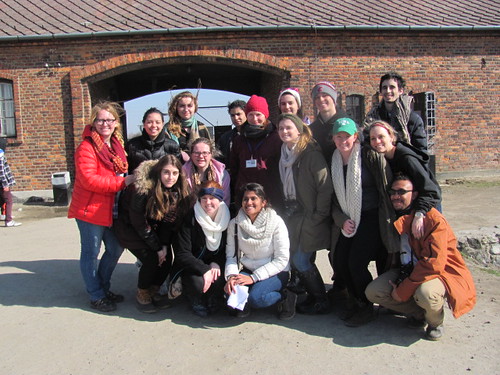
their own country? After visiting Auschwitz, it became nearly impossible for me
to believe that those anywhere near a camp could ignore what was happening
there. The camps were enormous, covering an incredible amount of space. I’m
sure at the time they were operating it was loud, smelly and again, nearly
impossible to overlook. Visiting Auschwitz and seeing just how close in
proximity some houses were to the camps, it was clear that residents of this
country were avoiding the issue. After learning about the torture, murder and
general mistreatment of the prisoners of the camps, it hurt me to think that
people could turn a blind eye. For me, it raised yet another important
question; what would I have done?
The
one question that particularly plagued me was as follows; how could a human
being with any sort of moral compass ignore the tragedies occurring right in
their own country? After visiting Auschwitz, it became nearly impossible for me
to believe that those anywhere near a camp could ignore what was happening
there. The camps were enormous, covering an incredible amount of space. I’m
sure at the time they were operating it was loud, smelly and again, nearly
impossible to overlook. Visiting Auschwitz and seeing just how close in
proximity some houses were to the camps, it was clear that residents of this
country were avoiding the issue. After learning about the torture, murder and
general mistreatment of the prisoners of the camps, it hurt me to think that
people could turn a blind eye. For me, it raised yet another important
question; what would I have done?
It
is so easy for me to sit here and say that I would have intervened. But what
would I have done? I could have joined the underground as some non-Jewish
members of the community had. But what if I had a family of my own and helping
those suffering would be sacrificing the safety of my own family? Would I have
been willing to make a sacrifice like that for people I didn’t know? In the
Holocaust kingdom, a non-Jewish friend on the outside of the ghetto saved
Alexander Donat’s son. This woman risked her life for another family’s child. I
have incredible respect for this woman and would like to believe that if I was
in her situation, that I would have done the same. But, once again, the
difficult part about asking these questions is that you are never guaranteed
and answer.
 As
thought provoking and frustrating as these questions are, they are nonetheless
important to be asked. Although it is impossible to answer these questions
because I am not in the position that these bystanders were in, it is important
to ask them because it shows that I am recognizing the need to look out for
those around me who are struggling. Despite not knowing what role I would play
if a situation ever arose, I am showing that I am aware of the need for people
to stand up and not be passive bystanders. To be socially conscious and active is
incredibly important. To raise questions like “what would I have done?” is
evidence of your inclination to do something. After seeing some of the horrible
injustices imposed on the victims of the Holocaust, I feel more inclined than
ever to not be a bystander and to use my voice against any wrong, either big or
small.
As
thought provoking and frustrating as these questions are, they are nonetheless
important to be asked. Although it is impossible to answer these questions
because I am not in the position that these bystanders were in, it is important
to ask them because it shows that I am recognizing the need to look out for
those around me who are struggling. Despite not knowing what role I would play
if a situation ever arose, I am showing that I am aware of the need for people
to stand up and not be passive bystanders. To be socially conscious and active is
incredibly important. To raise questions like “what would I have done?” is
evidence of your inclination to do something. After seeing some of the horrible
injustices imposed on the victims of the Holocaust, I feel more inclined than
ever to not be a bystander and to use my voice against any wrong, either big or
small. 


