Showing posts with label Sarah McIlwaine. Show all posts

Monday, May 7, 2018

Finding The Good, Amidst The Awful

Upon returning from Poland, many people have asked me questions about my experience and what I took away from the class and the trip. Some questions that always seems to pop up from time to time are questions about if the trip was sad or if it was depressing to see Auschwitz. At first it was difficult to answer these questions, not because I did not know what to say, but because of the shear amount of information and history that is behind each word, picture, and thought about the Holocaust. Although our time spent in Poland was physically and emotionally draining at points, I left our experience with a new outlook and understanding on the Shoah and the importance of seeing the hope that could be found amidst the tragedy.

A statue of Saint Pope John Paul II, located between his childhood home and the church he was baptized in.

During our time abroad we had opportunities to see the beautiful parts of Poland such as Wadowice. We visited Saint Pope John Paul II’s childhood home where I couldn’t help but be inspired by his life and his faith in God. As I reflect on the experiences now, after returning it is easy to overlook the inspiration that has come from Saint Pope John Paul II.

“I plead with you--never, ever give up on hope, never doubt, never tire, and never become discouraged. Be not afraid.” These words spoken by Saint Pope John Paul II hold incredible truth to his advocacy towards those who were murdered just miles away from his childhood home at Auschwitz. As part of his attempt to commemorate and remember the deaths of those who were murdered in the Shoah, he gave a speech at Yad Vashem, the official memorial to the victims of the Holocaust, located in Jerusalem. His speech mirrored the points made in the Nostra Aetate about promoting unity and honoring the memory of the Shoah. The theme of remembrance is found throughout both writings as well as the explanation of Jewish- Christian relations post World War II. Saint Pope John Paul II, used his platform to effectively advocate and be aware of the destruction that occurred in his home land. He is someone who brought goodness to the most awful of situations.

Our time in Poland consisted of 2 days walking the ground of Auschwitz I. I must admit the first day was very overwhelming, it didn’t feel real to walk on ground where millions were tortured and killed mainly due to what they believed. Religion has always been a large part of my life, which is why I was interested in the story of Maksymilian Kolbe, a Polish, Franciscan priest who fell victim to the Holocaust and was killed at Auschwitz. Kolbe was a Catholic friar who made the conscious choice to remain in the monastery after the war started. At the monastery, which was used as a make-shift hospital he continued to publish religious works for citizens during the war until he was arrested in 1941. During his time spent at Auschwitz (as prisoner number 16670) he was tortured and beaten for staying true to his faith.

During role call one morning the SS officers realized that a prisoner was missing. Due to the prisoner’s collective responsibility, they were punished and ten innocent people were sentenced to death by starvation. One of the people was a man named Franciszek Gajowniczek, who upon being called out began to cry out to his family. Immediately Kolbe, approached the SS officers and asked to take the man’s place. Kolbe was sentenced to death in place of the man, who ended up surviving Auschwitz and the Holocaust.

A plaque located on Block 14, the location where Maksymilian Kolbe stood up to the Nazi’s to take the place of a prisoner who was sentenced to death.

Kolbe demonstrated incredible faith and goodness up until his death in July 1941. We had the opportunity to visit the cell that Maximilian Kolbe was prisoner in for the 2 weeks with no food. Still during the most difficult points of his life, he managed to comfort fellow prisoners and hold mass and pray the rosary with others. Even at the moment of his death he exhibited grace and compassion, which is why Pope John Paul II canonized him as a saint. In the words of Father Manfred, “The Nazis may have killed him, but they could not kill his love.” He is someone who has allowed me to see the goodness of people throughout the worst of what humanity can bring.

This cell is where Maksymilian Kolbe spent 2 weeks suffering from dehydration and starvation until he was eventually killed by lethal injection.

Monday, March 19, 2018

THE JUXTAPOSITION OF AUSCHWITZ

Before my trip to Poland, I had many preconceptions and ideas of what I thought I was going to see and what my experiences would consist of. Although I had seen pictures, learned about the history, and heard stories from various people, nothing could have prepared me for stepping foot onto one of the largest mass graveyards in history. The experiences I have had during my time in Poland have truly opened my eyes into the cruel torment of people and dehumanization that existed only seventy-five years ago.
A view from underneath the sign at the entrance of Auschwitz I. This sign was often one the first sights that prisoners and victims would see before entering the concentration camp.
As I walked out of the gate of Auschwitz I today for I can confidently say will most likely be the last time, I couldn’t help but take a moment and pray for those who never had the opportunity to. The juxtaposition of the sign at the gate still haunts me. The sign reads “Arbeit Macht Frei,” which is translated to “Work Will Set You Free.” Unfortunately, for those who were forced to walk under the sign, they would soon realize it was a lie.

I stood for what felt like hours staring at the atrocity of the history that lie directly beneath my feet. I couldn’t help but take notice of the vast number of people with melancholy expressions and the sound of shuffling feet, it was almost if I closed my eyes I could be a witness to the first inmates of Auschwitz I. This experience reminded me of Alexander Donat’s memoir, The Holocaust Kingdom where he recounts the sounds and sights of his deportation to one of the camps. “When I reached the corner of the building, I understood the terror I had seen in everyone’s eyes. On both sides of us stood SS guards with grenades in their belts and submachine guns at the ready, holding barking police dogs straining at the leach. Never had I seen a collection of such murderous, degenerate human faces.” (pp. 140)

Throughout my time in Poland, I am constantly reminded of the importance of relationships between people. I find it difficult some days, with our busy schedule and the time difference to find time to talk to my mom, dad and brother, which are the most important relationships in my life. During one of our lectures with Fr. Manfred, (a German, Catholic priest who has devoted his life to studying and teaching German-Polish Reconciliation and Christian-Jewish Dialogue) he talked about the importance of our responsibility in relationships. One quote he said that stood out to me was “Relationships died at Auschwitz.” The horrific torture of the people brought to the Auschwitz camps was not only cruel but dehumanizing.

After spending what could have been weeks in cramped cattle cars, the inmates of the camps were stripped of all their possessions and separated from their families. As if this wasn’t cruel enough, they were subjected to brutal shavings and inhumane conditions. “We were told to strip; male barbers shaved our heads and the rest of our bodies with clippers. A girl rubbed each of us under the arms and between the legs with a rag dipped in disinfectant....as new arrivals went up to them in turn, they made adroit pricks in the skin with a tattoo needle on the left forearm.” (pp. 260)
Suitcases belonging to those who were brought to Auschwitz. In order not to panic the masses of people, SS guards allowed people to pack items they thought they would need, only to have it be collected upon entrance to Auschwitz, yet another juxtaposition.
As I look back so far on my experiences in Poland, I cannot help but think about the future that lies ahead. I think about explaining each and every picture that was taken in detail in order to spread the knowledge of what I have learned and to be a voice for the 6 million people that are now voiceless due to the Shoah. In the Nostra Aetate, written in 1965, there are many questions that come forth regarding what we can do now that the Shoah has ended. “Whence do we come, and where are we going.” (pp. 4) Moving forward from our experiences in Poland, I hope that my knowledge and improved language allow me to advocate for those who suffered and were senselessly killed.
Some of the innocent victims who were stripped of their identity and forced to work in Auschwitz during the Shoah.

Our Duty To Remember

Today is our last full day in Poland. I am filled with emotions as I sit on the bus to Kraków for a long and full last day. As I look out the window, I am reminded of the opportunities that I have been given and how I can use these experiences to advocate and teach others. This week, I have been exposed to many different elements which have left me speechless, yet still I feel the desire to talk about each moment in such detail. The physical aspects of the Auschwitz camps are something that cannot be explained by pictures alone. Many friends and family have been asking what his trip has been like for me and it is impossible to describe my experiences in the short time that we have to talk. When I return to America, I believe it is my duty share the knowledge that I have learned throughout this experience. During one of the first classes we had, Dr. Procario-Foley shared with us the importance of being a witness. After hearing the testimonies of survivors of the Shoah and walking in the footsteps of those who have suffered, I am inspired to continue to share their stories.

Looking out at the immense size of the camp from the watch tower at Auschwitz II – Birkenau.
Upon arrival to Kraków, we visited the JCC (Jewish Community Center), which is a center focused on reviving the Jewish community for all generations. The center started only 10 years ago after Prince Charles visited Poland and spoke with Holocaust survivors about what their needs were, to where they explained that a place of community was needed. The JCC is a great example of how today’s Jewish community can come together a move forward from the destruction caused during World War II. At the center, we heard from a Holocaust survivor named Zofia. I was extremely impacted by her story of survival. She talked about the many obstacles she faced, one which was when her and her family were blackmailed. “Worst moment of my life - we were blackmailed when someone came to my apartment. My mom was terrified. We gave him money, clothes, and whatever else he wanted. After he left, we escaped.” (Zofia, 2018) In class we talked about the many sacrifices that Jews in Poland had to make in order to be kept out of the camps. Zofia admitted she knew she and her family were Jewish, however she was still baptized and learned about the Christian culture so that no one would suggest she was a Jew. Her story concluded with an uplifting quote, “so I am here now, safe, happy and lucky.” This brings me back to what I believe is one of the most important aspects of this trip; it is our duty to remember.
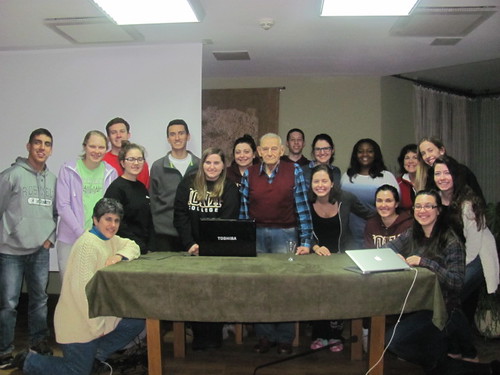
The group posing for a photo with Zofia, a Holocaust survivor after she shared her story.
This theme of remembrance is clearly outlined in not only the Nostra Aetate, but also in the 1998 document written titled We Remember: A Reflection on the Shoah. This document was significant in many ways, one being that it was the first time that the term “Shoah” was used rather than Holocaust. This clearly showed the empathy and growth in the relationships post World War II. Both documents show steps towards moving in the direction of understanding that the murder of 6 million Jews, cannot be forgotten. Whether it be reading and listening to stories or visiting and learning about different sites we have as a group become witnesses to what happened during this dark period in history. I now understand the important of being a witness – it is to share the stories that have been passed down from generations and to share the cold, dreary atmosphere of Auschwitz so people will never doubt, question, or most importantly forget about the Shoah.

I am a witness and I will not forget.