Monday, March 28, 2016

How to Witness the Shoah

Stepping out of the plane was a relive of plane encapsulation for a twelve-hour period however, knowing the week we have in store balances into a long and intense experience that I for one haven’t encountered (until know) and will never forget. The past eight weeks have felt enough information to making it though the week fell. The Holocaust Museum, two films, and an account from a survivor (one survivor talk in store this week) have taught me how to be a witness well not becoming a bystander and I will be share to come back to becoming a witness.
The first witness to my learning of the Shoah was arriving to the Pray and Dialog center and meeting sister Mary. The center is similar to a peaceful resort even though the center is placed across the street from Auschwitz I. Sister Mary is someone that confirms and helps organizes our schedule for the week, she also helps if I have any questions on any experience I have throughout the week. She reminded me of both my great-grandmother and grandmother not only because they are not Polish but they have the voice of a soft-spoken was one one of the first interactions had in Poland culture. Before the first night ended she described four main points to take into account while studying (observing) the Shoah and traveling to Poland (Auschwitz/ Oswiecim):
·      Listening to the voice of the earth… 
            The earth is the atmosphere that we live. Similar to everything on earth, we have to have knowledge of the object we have to get a sense of its capacity, living. A survivors testifying to the 225 thousand people that lost their lives of Poland.
·      Listen to your heart…
               Looking at the World status today and trying to view the value and hope that still exist today. There are the good people but the good is canceled when there is terror in the world, the value and hope will then get reevaluated until the good is restored.
·      Listen to others…  
            “Touching a worn will hurt but around the worn will make it feel better,” survivor’s testimonies of the Shoah will hurt when discussing the cruel events that occurred to them and for some will be relived that each account is shared.
·      To listen to the voice of god…
            “Why am I here, respect what can’t be said.”
These main points are in relation to Nostra Aetate by being able to discuss religion with anyone without consequences and discussing what makes a religion and how everyone translates all meaning a specific religion.

Taking the four points in mind I toured two cemeteries of Oswiecim. One that was destroyed because of anti-Semitism but then later preserved for a memorial. The destroyed cemetery during the war was preserved to a meaning of reflecting on the six million people who both are survivors and who lost their lives. Each individual grave stones were scattered in an order fashion with some stones having a digit on the back side of the grave because some stones where not readable by the destruction of the grave yard. The numbering on the back reminds me of not the name of the person but the number that was giving during imprisonment by the Nazis. A couple of kilometers further was a living cemetery. Like any modern cemetery, the second one was organized and present with people of all identities roaming the ground to remember their loved ones that have past. When walking though the both cemeteries I noticed the layout and mood if the cemeteries and both brings peace to the living and the died.


Destroyed Cemetery 


-Elijah Ziobron

Sunday, March 27, 2016

Finding a Moment of Peace in a Place of Devastation

The front gate of Auschwitz I. "Work Will Set You Free".

Before entering the gates of Auschwitz I, I had this assumption that I would feel angry throughout the tour. My assumption was correct, though not for the reasons I originally thought.

Originally, I thought I would be angry because of the visuals the museum preserved and their explanations, but I was angry for a different reason. I was more angry with the people around me in other tour groups than I was with what I was seeing in the exhibits.

I understand that anyone who is going to Oświęcim is going to take a tour of the Auschwitz sites, but it felt like the other people were there just to say they went there, not because they actually wanted to learn or see the sites for themselves. Our group was there to learn more about the occurrences; we weren't there just because it was a tourist attraction.

I even saw a girl who looked like she was around my age taking a picture in front of one of the guard towers...of herself...smiling. Yup, you read that correctly. She stood in front of the electrically charged barb wired fence and guard tower that enclosed the camp and smiled in the photo. I cannot express how infuriated I was at this moment. It's one thing to take a photo like the one above, of you or someone else standing looking at one of the exhibits, or even one of you walking through the camp, but to stand in the camp and take a picture of you smiling is utterly disgusting and outright rude.

I cannot imagine what life was like in between these electrically charged barb wired fences.
Walking through the fences pictured above to get to the final part of the tour gave me a weird feeling. I cannot, and never will be able to, understand what emotions and thoughts I would have if I were to walk through them to my death by gas. At this point, for the second time, my heart was in my throat. Just thinking about what those poor innocent people went through on those grounds every day for however long they survived through the torture is enough to make me feel sick, but what I was to see next would make me feel sick to my stomach.

After passing through the double fences, we walked through the gas chamber of Auschwitz I. Walking up to the door to the chamber made me feel sad, anxious, and angry all at once, but those feelings quickly changed to a feeling of being overwhelmed. While walking through the chamber I could picture all of the people crammed together inside the room clothes-less about to die without even knowing what was coming next. My chest began to feel tight and all I wanted was to run out of the building. The moment I exited the building my chest felt normal again and I felt relieved.

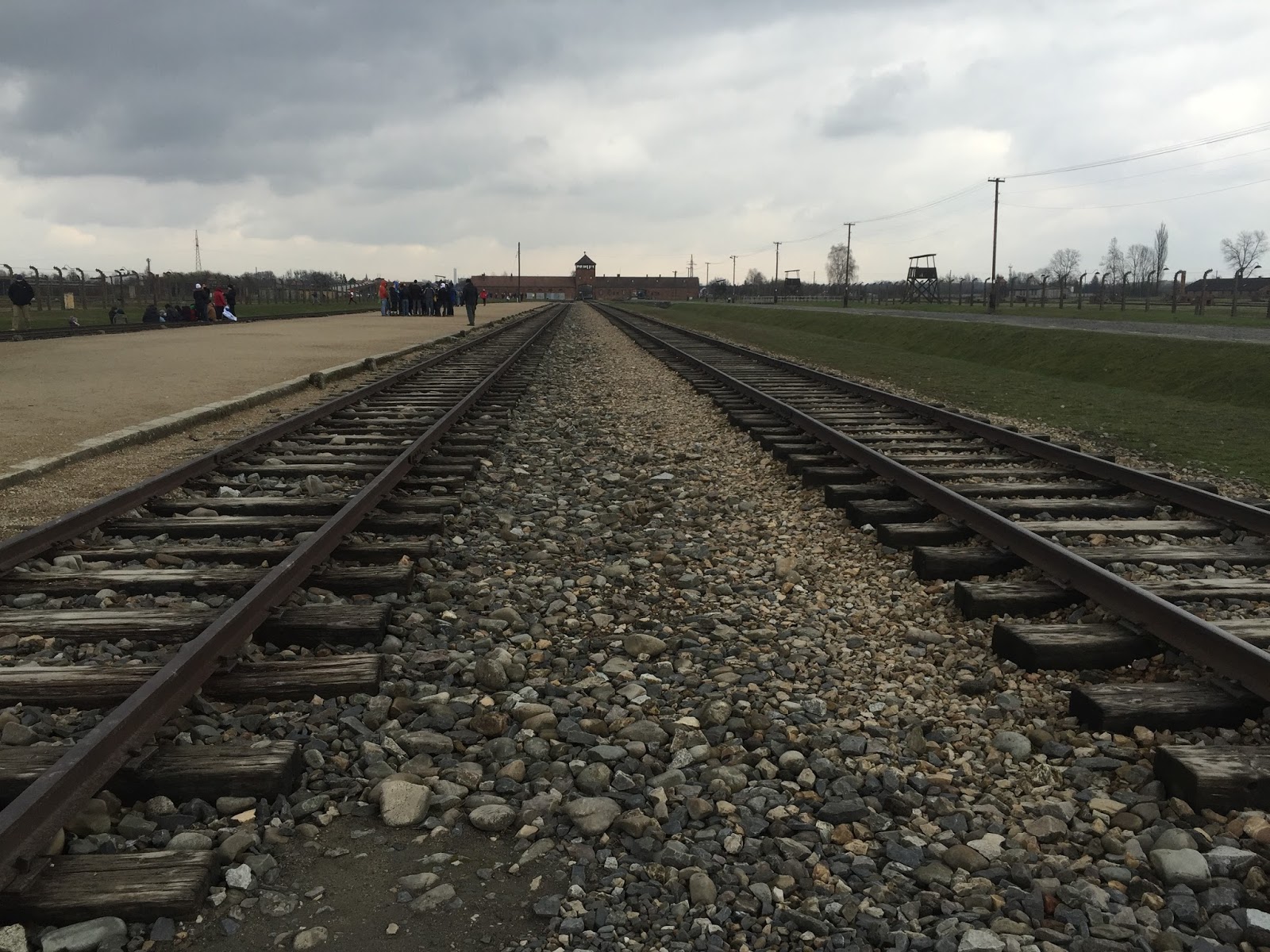
Deportees would eventually be freed from the cattle cars directly inside the Birkenau walls from these train tracks. From this area, the selections would be done and people would be sent either to the left or to the right.
Walking through Auschwitz-Birtkenau was a totally different feeling than the feeling while walking through Auschwitz I. Birkenau provided a more sickening feeling since the whole area was in the open air and you could see more of the living conditions. Even just the visual from the photo above is enough to send chills down my spine; I could never imagine, nor do I ever want to experience, the feelings the deportees felt while getting off the cattle cars and walking through the camp.

Here was where I felt anger throughout the tour. Walking from barrack to barrack, the feeling of anger only increased. Seeing the destroyed gas chambers and crematoria made me feel slightly better though. Knowing that the Nazis were too coward to let others see what they were actually doing to the Jews inside the camp made me laugh of irony. One would think that the Nazis would not have had any problem with letting the outside world seeing what went on inside the fences after the war was over, but no, they were too coward so they bombed four out of the five chambers. I also felt slight triumph knowing that some of the Jewish prisoners blew up chamber #4 as an act of rebellion.

My moment of peace, however, came when we were at the rubbles of chamber #2. While we were standing there and listening to our tour guide speak about the chamber, I was taking a video of what the remnants looked like and when I got to the end of the remnants I stopped walking and saw a baby deer or some sort of woodland creature run through the grass. At that moment I felt like a huge weight had been lifted off of my shoulders. A slight warmth engulfed me for a moment. To me, this event symbolized a victory the victims had over the Nazis. Unfortunately nearly 6 million people perished, but in the end the victims won. The Nazis not only lost the war, but they were too coward to let their horrible acts to be seen. Also, the victims won because their groups of people are thriving today and overcame what the Nazis did to them at that time.

That moment was what I was looking for for so long; I finally found my peace and I am eternally grateful for having the chance to find it.

That's all for now folks. Check back soon for more!

I found God - Kristie Botti


It has been a full day on US soil and I have done nothing but reflect back on my experience in Poland. Being bombarded by family members asking how my trip was and being faced with assumptions that Auschwitz is such a horrible place. Well yeah of course it is not Disney World, but it has caused me to do things and think in ways that I have not done so in quite sometime.

Before I left for Poland I was nervous. Nervous about how I would react to walking the land where millions were killed. Nervous about whether I would be able to establish a bond with my classmates. Nervous about whether I would find God in a place of destruction. I was nervous before I left for Poland. During the week I was faced with many what ifs and questions in regards to the Holocaust. Where was God? How do people become mass murderers? All of these questions that I was unable to answer were clarified throughout the week.

The first few days of visiting Auschwitz were hard for me. I did not break down, I did not become emotional, and in fact I did not feel much. I was numb and unable to imagine how someone could think up all of the ins and outs of the process in which the prisoners were taken through. Why were the Jews targeted? I learned that when Adolf Hitler took over Germany he wanted to “Make Germany great again” and get rid of anything that could impact that from happening. He saw Jews as a threat and wanted to make Germany clear of all threats. Therefore, he minimized their location throughout the country by forcing them into ghettos. From there, they were deported to concentration camps where they were stripped of their identity and transformed into just a number. I could not even think that God was anywhere near these occurrences because why would he let this happen? Then Wednesday came along. We were involved in a multi-media lecture. This lecture included questions displayed on a computer screen in which you could click on to reveal multiple videos of speakers answering those questions. All of my questions were answered on this day.


Where was God? How do people become mass murderers? What I learned in this multi-media lecture was that God does not control our actions. We are all born with good and evil inside of us and it is up to us how we will act. God does not depict which one we choose to use; he just supplies us with the ability to use one. Therefore, God was there the whole time. He was the hope inside each and every one of those survivors. He was the people that helped prisoners escape. God did not cause the bad. Human dignity is what caused the bad. People are born with good and bad inside of them some just exploit their bad intensions to a maximum. That is what creates mass murderers. That is what caused the Holocaust. The lack of human dignity and the exploitation of the bad is what caused the deaths of millions of innocent people in Auschwitz. 

Before I left for Poland I was nervous. Nervous about how I would react to walking the land where millions were killed. Nervous about whether I would be able to establish a bond with my classmates. Nervous about whether I would find God in a place of destruction. I was nervous before I left for Poland. I left Poland a new person. I left Poland with a new mindset on human dignity. I left Poland with a complete understanding of where he was. I found God. I found God in the concentration camps of Auschwitz and Birkenau. I found God in Sister Mary, Dr. Procario-Foley, and Dr. Rozensher. I found God in my 14 incredible new friends who I admire so much. God was there and he continues to be here. He is who led us all to join this class. We are now witnesses and as the survivors of the Holocaust begin to decrease in number we will be the ones to share their story. I am a witness and I will not be a bystander. It is up to us to make a difference in this world to ensure that this will never happen again. Thank you for an incredible experience Poland.


Seeing Europe Through a New Lens: Auschwitz 1

The gates of Auschwitz 1

Auschwitz is an indescribable place so I believe the best way to convey it to readers is through my raw emotions.  It was like walking into an all-encompassing feeling of devastation and pure shock. Even if you were to  study  Holocaust history, learn about the concentration camps,  read every book and analyze each memoir nothing can prepare you for physically stepping foot into Auschwitz.  The greatest realization was I knew in the back of my mind that at any moment I could leave whenever it was all too much to bear, but that wasn’t a choice the victims ever had. 

The first question I had, as I became a witness to the unimaginable conditions behind the barbed wire was, “Where was God?”  Faith is the foundation of my life and it is very important for me to find God and turn to him even in the worst of times.  I was relieved to hear a story in the beginning of our tour of what I believed was Gods presence within the camp.  I have always believed that God is present in even the darkest moments and sometimes he carries out his most prominent works through people.  Maximilian Kolbe is a prime example of God’s presence within the concentration camps.  He sacrificed his own life for another prisoner who had a wife and children.  I believe this testimony gave me the strength to get through the entire tour.  God never abandoned the victims of the holocaust and he did not abandon me during the rest of my tour. 
Book with names of victims that were murdered during the Holocaust 

On the tour we wore headphones and our passionate guide poured terrible yet gently spoken statements into our ears as we watched the unfathomable unfold before our eyes.  One of the first exhibits we went to, featured video footage of victims of the holocaust before the war.  We saw their carefree, normal and every day lives.  It broke my heart to think that they were robbed of the happiness I saw on each of their faces.  The next room we walked into was filled with a book that was much taller and wider than it ever should have been.  Unfortunately within this massive book were the names of those that perished.  It was while flipping through this book that I realized it was not just a general group of millions that died at the camp.  Instead it was millions of individual lives- each with a name, a family, a story and a purpose.  Each person murdered in the holocaust doesn’t have a book about him or her, or a museum, or even a tombstone.  I couldn’t help but feel like it was my job to make sure the memory of the individuals did not die as well 


Hydrogen cyanide, form of Zyklon B (chemical used in the gas chambers)
We were given the facts.  I told myself not to overthink anything that was told to me because I knew I would get overwhelmed with  pain.  I remember staring at the light blue pellets used to exterminate victims in the gas chambers and feeling numb.  I then saw a pile of glasses and realized I was wearing mine too.  If this horrific event were happening today my glasses would have undoubtedly been in that pile.  We looked at a heap of shoes, suitcases, and hair combs that were previously owned by prisoners.  If that wasn’t hard enough we then entered a room with mounds of human hair.  I felt my heart sink and was surprised I did not pass out at the sight of it.   At first I thought it was inhumane for victims hair to be put on display but then I realized that it was exhibits like that, which made the holocaust real and undeniable.  I later learned that the hair was not being preserved and was being left to take its natural course of disintegration.  Something that I found just as hard to discern was the plates and household items the prisoners brought with them to the camps.  It made me understand that they truly had no idea where they were going.  Some even brought cosmetics and formal attire so it was very difficult to look at the blue and white-striped uniforms hanging upon the walls that ultimately ended up being their reality.  These everyday items, that we all handle, these bits and pieces of humanity helped to drive home the point that this could have been any one of us. 


Glasses taken from prisoners at the camp

Our last stop on the tour was the gas chamber.  I walked in closed my eyes for a moment to collect myself.  I was standing in the spot thousands of people took their last breath due to hatred.  I was able to pump air through my lungs without fear, unlike those souls who came before me.    I was able to look around at my group of peers and know that we would all exit the chamber safely.  It made sense that it was raining that day because my feelings were as dark and gloomy as the weather. Still in all of the darkness I witnessed, there was one candle I could light.  My visit to Auschwitz lit a spark within me that I will never let fade.  That fire will burn bright each time I think back to my experiences at Auschwitz. I will be inspired to stand up for social injustices.  I will never forget, always advocate, and never be a bystander from now on. 

Loving What We Can't Understand

Today we leave Poland.  Visiting this country was an honor and a special privilege that all of us were able to experience.  My perspective of the Holocaust has completely changed throughout the course of 7 days.  At the end of this trip I have realized one thing.  We really will never fully understand what happened during the Holocaust and why it happened.  However, being able to come to Poland and witness the remains the grounds of where it took place has definitely deepened my understanding. My thoughts on what I believed happened during the Holocaust are completely different then what they are now.  I don’t care how many videos, books, and courses somebody has been exposed to.  You learn so much more by physically being here.  There is nothing quite like seeing the streets where once stood ghetto walls, seeing the grounds of the camps, and hearing the stories of survival, hope, and evil. 

One important thing to remember is that you cannot understand the Holocaust without remembering the millions of stories of the lives of each person affected by it.  There are multitudes of individual people that fought for their lives during this time.  You can know that millions of Jewish lives were taken away (over 6 million) but we also have to remember that these are millions of names and stories, not numbers.  Each of these people had lives just like you and me.  College students couldn’t go to school, families were separated from each other, babies were killed for no reason.  Individual lives were completely changed and thrown into one same fate.  Father Manfred told us in his lecture on Thursday that these people were categorized into one stereotype.  However, I will now never forget that each person in life has a name and dignity, you are not just a stereotype. 

The biggest problem of the Holocaust that Father Manfred said that we struggle with is ethics. The question is not where was God, but where was the human being? God is in the dignity of every person.  People encountered God when they decided to recognize or ignore each person’s human value.  Where was the human being to take responsibility and show respect for the life of others? Sometimes people did, and a lot of times, people suppressed their empathy for others.  But why?

In life evil will occur, because evil exists.  Humans have free will, given from God and we can choose to do good or evil.  God does not control this act.  However, we have to learn to love above all else.  To love even what we cannot understand.  I will never understand how the lives of so many people were taken away so efficiently.  However, I do know this.  Love never fails, and though I cannot understand why so much evil in the world happens.  My experience in Poland this week has helped me understand this: despite all our doubts, I need to and will continue to strive to love God and everyone in my life.  Hopefully we will understand, when it is our time, but for now, we are called as Christians to love.  And despite all these questions, I will choose love.


Thank you to Dr. Procario-Foley, Dr. Rozensher, and the rest of my classmates for an experience I will never forget.  I will cherish everything I learned with you and about you!  And to anyone reading this blog, push yourself to be a voice for love in action in the world.