Sunday, March 15, 2015

Dizeń Jeden


We’re Here!

After hours of flying, we finally arrived to our home for the week and started the day! There was no time to rest after two flights - one for seven and a half hours to Berlin, Germany and then one for an hour and a half to Krakow, Poland. 


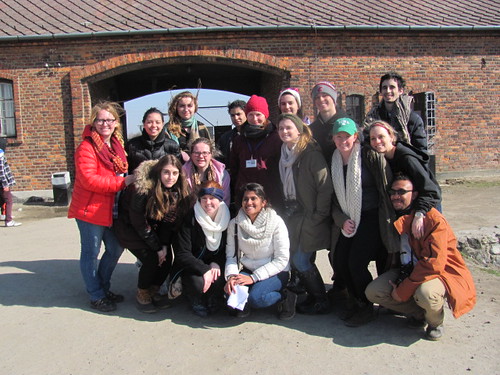
We are staying at the Center for Dialogue and Prayer in Oswiecim. We had the pleasure of spending the day with Sister Mary O’Sullivan as our guide. She told us all about the center. Cardinal Macharski founded the center in 1992. The Center’s mission is to honor the memory of all the Holocaust victims and offer peace and reconciliation to the world. They welcome groups of all ages from all around the world with tremendous hospitality and great food. See left a picture of Dr. Procario-Foley leading us in.


After learning more about Auschwitz and Jewish culture at the Auschwitz Jewish Center, Sister Mary took us around the town showing us many important spots of Oswiecim. She took us down, what used to be known as, the Jewish Street - see picture to the right. On this street we saw the spot that the Great Synagogue would be today. The synagogue used to be a center for Jewish culture and education. The Germans burned it down in November of 1939. The only remains of the synagogue are an empty field and a sign to represent its place – see picture below.


Sister Mary took us to the square in town. She was telling us about the market space that the square turns into. Back before the Holocaust, Jews would be the main sellers at the market. Although Oswiecim used to have a high population of Jews, not one Jewish person lives in the town today.

One main reason why there are no more Jews in this town is because the death, concentration, and work camp, Auschwitz, is located here. I can see the camp from the Center for Dialogue and Prayer. Although the location where thousands of Jews had been murdered is right across the street, the Center for Prayer and Dialogue has been very comforting and welcoming. 


Lastly, Sister Mary took us to the Jewish Cemetery. In 1939 when the Germans invaded they destroyed the cemetery. There was an eerie feeling that came upon me when I walked into the graveyard. Moss was growing all over the tombstones and many of them were broken. None of gravestones were in their correct place. It was very emotional. You could feel the spirit of the ground.

I thought back to the car ride from the airport to the center. I had seen two cemeteries in the hour trip. Each tomb was covered with beautiful, colorful, fresh flowers. The whole cemetery was colored like a rainbow. 

Comparing the two places was so disheartening. Every human being deserves a place to rest after they pass. Seeing the two reminded me something that Maestro Sidlin told us in our class: Jews had everything taken away from them - even their cemeteries. 

On a lighter note, below is an adorable picture of a nun playing tennis. Also, Fred has fallen asleep at every location today because he did not sleep on the plane. However, Fred did stop our van from rolling back into traffic. 
Poland 4, Fred 1.


Friday, March 13, 2015

POLAND, Here I Come!

Iona College-Daniel & Me

Friday 12:30pm and I am still packing. Last night, I was running to Marshall's at 9:30pm, right before closing to buy a converter for my chargers. Calling my professor twice at night, because I was still unprepared. Show's how on time I know how to be. I am excited and nervous at the same time. I do not know most of my classmates going on to this trip but that is where 7 hours on a plane will help. I look forward to getting to know my classmates. As I've been told multiple times this is a life changing and emotional experience. I know my Professor and classmates will be there for moral support. But I am going to miss my buddy, Daniel. I made him and my family download the What's App just to stay in contact with me over the break! I cannot be any more excited to go on this new experience. It will be my third time out of the United States. It is only my first blog post and I am not even sure what to be writing. I am sure more will come after tonight's plane ride(:

By: Jordan Galindo 


Thursday, March 12, 2015

Peace Out America! Ashley Hubaykah

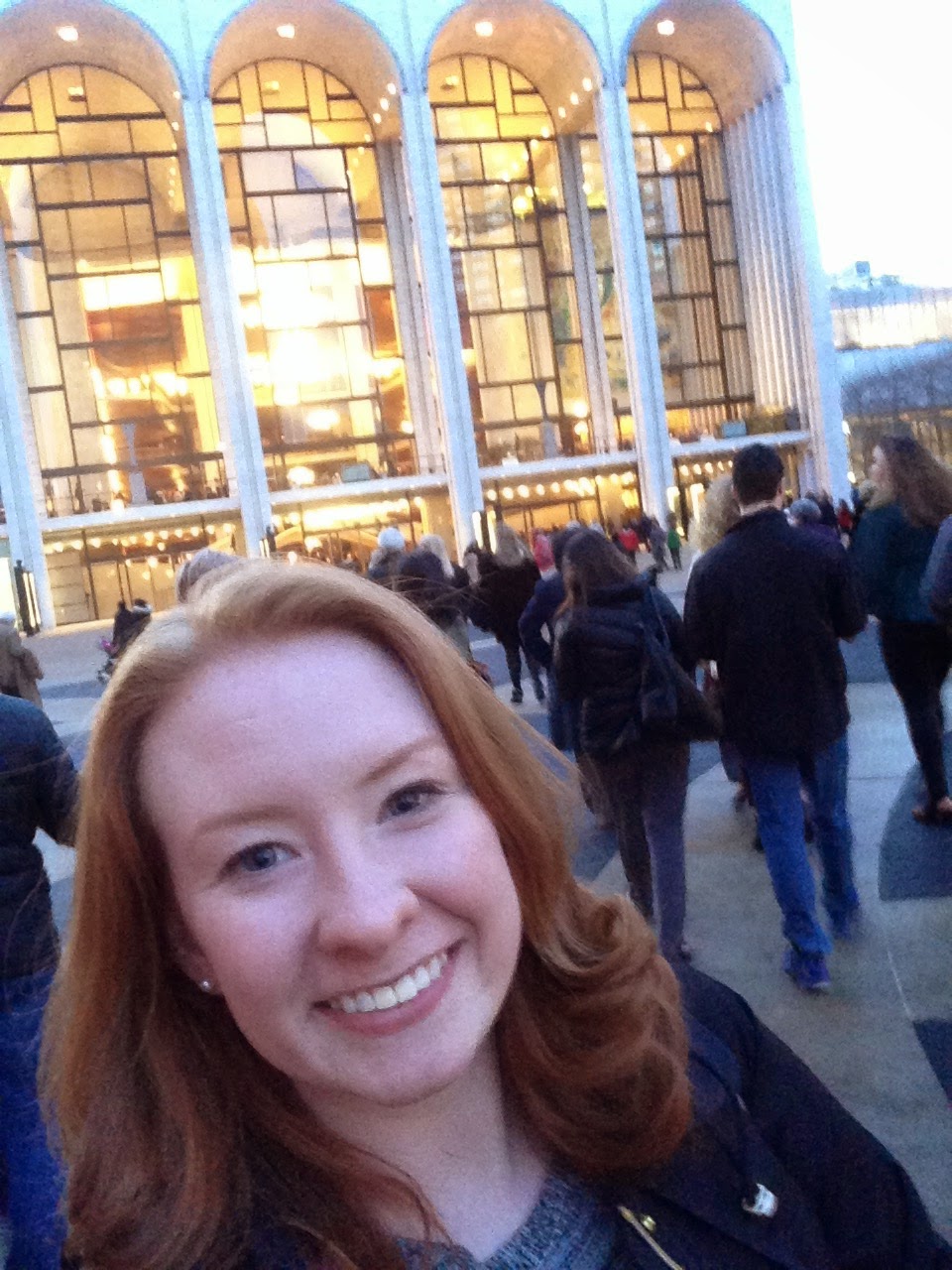
Greetings from Lincoln Center!
 
And so the countdown begins! Tomorrow I leave for Poland and I have yet to even pull out a single article of clothing, let alone a suitcase! I usually work well under pressure, but this shall be the ultimate test!


I mentioned that today begins the countdown. But really, the countdown began Monday at 7:30pm night at Lincoln Center. My class received the opportunity to watch a live performance of the Defiant Requiem Verdi.  I have never been to an orchestra type of performance or even to Lincoln Center so I was definitely excited and looking forward to the show. Also a lover for music, I’m always amazed by the talents of artists. They definitely blew me away. Although the performance was in Latin, I followed along the best I could. The performance still proved to be a grand performance showing me that music could be a living memorial. 

Murry Sidlin, the conductor of the Defiant Requiem spoke to our class about the story behind the performance. The Defiant Requiem was directed by Raphael Schächeter at Terezin and performed by prisoners at the camp just out of Prague. The practices held by Schächeter were a symbol of hope for the prisoners of Terezin. While the camp may have physically captured the prisoners, the Defiant Requiem reminded them that they could not capture their souls.


We sat in the third level box and down below I had a view of the violists, pianists, singers, choir, and even people on the French horn. I was amazed by the energy of Murry Sudlin and the simultaneous flow of all the instruments as one.  My favorite part of the performance was the Agnus Dei and the symbolism behind the closing of the show.


As the performance finished, performers started exiting off the stage one by one. At first, I did not know what was happening. But, than I quickly realized it symbolized how people disappeared one by one in the Holocaust. Once they all exited, one violist remained. His solo was such an incredibly powerful moment. That was when the performance came full circle and I could feel why they exited the way they did.  


The performance for me was about giving a voice to those who would never have one again; it is about affirming those people and letting them know they did and still do matter. At the end of this show, we were not only asked to hold our applause until the very end, but also to hold a moment of silence for all those victims. 
I am extremely grateful for the opportunity to have attended the Defiant Requiem. I’m also grateful that the next time I blog it will be in Poland!  


Till next time readers! It’s time I actually start packing my suitcase! See you in Poland! 

View From Our Seats!

Check Out My Ticket!


Wednesday, March 11, 2015

Ready For Poland -Maria Wik


My mother and I in Switzerland from this past summer.
My name is Maria Wik, and I am currently a sophomore at Iona College. I’m studying Mass Communications with a focus in Public Relations. Traveling has always been a passion of mine. I went on my first European adventure when I was only 7. From then on out I have been pulled to travel and explore new places, experience new cultures and learn about the local history.  I find history to be quite fascinating because even the events of yesterday build the foundations to the events to come tomorrow.

 I come from a family with mixed nationalities and religions, for example my father’s mother is Jewish and I am Catholic. Since the first time I learned about the Shoah, more commonly known as the Holocaust, I wanted to know more.  With this being said, it only seems right for myself to have such a strong desire to go to a concentration camp and fully immerse myself in the history and culture of not only the camp but also the local culture.

When I tell people I am spending my spring break in Auschwitz, I get two types of responses. There is one response that is just the confused stare followed by “That will be fun.”, while on the other hand there are the people who ask questions and talk about how life changing this will be. I still find myself in disbelief that I am leaving in 3 days. Everything I’ve heard, read and watched will now be right in front of me, it will all be real. In class the other day we were talking about things we are worried about and the most common response was just that, ‘it will be real’. The things we’ve watched in the movies will no longer be just anther Hollywood exaggeration; it will be show stopping real.
           
I find myself with so many emotions. I am experiencing excitement and dread, eagerness to learn but also fear for the brutal truth. At the end of the day, however, I could not be happier to be going. I will be surrounded by a group of friends who are just as passionate about this as I am.  I hope that in the next two weeks I get answers to the questions I have been asking my whole life.
                                                                                                             

Tuesday, March 10, 2015

Time to Get Packin'


Hi! My name is Meghan Cramsie and I am a junior at Iona College. At the end of week I will be in Poland!!!

My Catholic identity is very important to me and I have participated in many opportunities offered by the Office of Mission and Ministry. I am a student campus minister in the Christian community on campus and I organize all of Iona Masses. In the past two years, I have been to Detroit and Washington D.C. on mission trips. I got the chance to travel, explore my faith, and serve others less fortunate than I am. However, this year I did not feel called to any of the mission trips offered, but I had heard about the Poland study abroad trip from some friends who had gone previously.

Being a business management major, I do not get to take many classes that teach me or let me explore my faith. I was excited to hear that the class was with the  religious studies department but I was even more excited to be going to a place with such a profound and intense history. I also have never been out of the country...


So, I took a leap of faith! 
This will be my first time leaving the country. I have my fresh passport and a pocket full of zlotys!


On Monday, March 9th, my classmates and I got the chance to attend the Defiant Requiem at Avery Fischer Hall. It was a wonderful experience!

I was nervous that after a full day of classes and work, I would get to my to seat and fall asleep – but I was completely wrong! Our class sat together in box 9 where we could see everything!! 

Though I could not understand the words the choir was singing because they were in Latin, I tried my best to follow along with the translations that my professor had given us before the show. Each section was separated by survivor’s testimonies whether they were videos of them or read aloud by someone else. 

We had the pleasure of meeting the conductor, Maestro Sidlin, who showed us the documentary that described the work behind the Defiant Requiem. We learned about the history of Terezin and the choir led by Rafael Schachter. 

The end of the concert gave me the chills. 

The choir had finished singing their last section of "Libera me". They sang "deliver me, O Lord, from eternal death on that awful day. Deliver me" and the train whistle blew... 

In a straight line, all the men and women from the orchestra and choir walked down the long aisle while humming a dark and depressing tone. One by one, they walked in their matching black outfits out of the concert hall; who knew where they were going. 

The Defiant Requiem, our textbook called "The Holocaust Kingdom", and many of the documentaries we have watched in class have been helping to make the Shoah, more well known as the Holocaust, very real to me. While excited to travel to Poland, the things I will experience on my trip and the emotions I will feel will not be easy. But I feel well prepared by my professor and with my classmates by my side. 

"Lacrymosa dies illa, qua resurget ex favilla."


Saturday, March 7, 2015

One Week Till Poland-Ashley Hubaykah

Ashley Hubaykah
Religious Studies and International Studies Major
Class of 2016


Greetings readers to my first blog ever! My name is Ashley Hubaykah and I am a current junior at Iona College. I am originally from Tampa, Florida. I’ve chosen to double major in religious and international studies with minors in French and Spanish. I am excited to start my first blog ever for my spring break trip to Poland for my religious studies class Memory and Reconciliation.

I have heard that once you start traveling, you cannot seem to stop. In fact, after spending the summer in Valencia, Spain, I diagnosed myself with the travel bug; Valencia, Ibiza, Barcelona, Paris, it all just left me wanting more of Europe. Prague, Athens, and Munich all were and still next on my list. 

I did not picture my next trip to be the ultimate test of faith and humanity. For one week, I will be immersed in Oświęcim, Poland- the site of Auschwitz. Currently I am a Lipper Intern at the Museum of Jewish Heritage-A Living Memorial to the Holocaust. While the extensive two weeks of internship training and weekly visits to the museums have sparked a new area of research for me, it could not prepare me for the horror I am about to feel in a week.

It seemed like a simple decision to go to Poland- I am a religion major, Dr. Procario-Foley is my advisor, I am an intern at the Museum of Jewish Heritage-A Living Memorial to the Holocaust. Why not go to Poland? In just a short two months, the trip has evolved into so much more. I’ve listened to lectures on the culturally rich Terezin, cried during survivor’s videos, and learned how Jews and Christians are more related than I could have ever imagined.

I can let you in on a little secret and that is my endless curiosity about the Holocaust. I ask myself everyday how could something like this happen? How could 11 million people possibly be murdered? Did God really not make us all inherently good? Why do I want to study and visit a place that reminds of the cruelty the human race can have towards one another?

I am not sure if I will even receive any answers or closure for my curiosity. If anything, I might come back with more questions. But Elie Wiesel says that we must, “Help one another. It is the only way to survive.” I do know my professors, my classmates, and my faith will help me to survive what is about to be the cruelest dealing I have ever come face to face with. 

Thursday, April 24, 2014

Goodbye Poland. - Kara Pacewicz

It has been over a month since leaving the most inspirational and moving trip of my life. When looking back on my old blog posts the emotions all came rushing back. The experience of Poland was so unbelievable that it almost feels as if I didn’t go on the trip. Since the trip any chance I get I share my photos and experience with everyone. The knowledge I achieved from this course and trip is more than I could have thought. Being there and experiencing it all made it all so real and it gave the history life. Not only did I learn an endless amount of information on the Holocaust but I also learned so much about history and the affect it has on our present and future lives. This trip has given me a passion for learning about the Holocaust and understanding the event in history. Since the trip I have done so much research on my own, read books, and looked up pictures from the Holocaust.

The thanks I have for those who helped make this trip happen can not be expressed enough. Dr. Procario-Foley has put together a trip for students that changes lives. With the help of Dr. Nadel, Sister Mary, Father Manfred and the rest of the staff at the center made this trip one of a life time. They all give students like me the opportunity to bring history into real life. It gives us a knowledge about the Holocaust and religions in a way we would never learn in a classroom. They also give us a chance to have a life changing experience.

I hope some day I can return to Poland and go back to the camps. I feel as if the knowledge never ends. A new goal of mine is to visit the rest of the concentration camps standing and to gain knowledge of what happened at those camps as well. The decision to join my classmates in Poland is the best decision I have ever made, the trip opened my eyes to history, gave me a passion for studying the Holocaust, and it changed my life forever.
New York City from the plane ride.

Thursday, March 20, 2014

For them, tomorrow simply never came. Today, we walk in their footsteps.

Possessions of the Victims of Auschwitz I

Display that contained 40,000 pairs of shoes left at Auschwitz

Prayer Shawls from the victims of Auschwitz I

Eye glasses from the victims

Pots and pans from the victims


            Going to Auschwitz I and Auschwitz-Birkenau concentration camps was like entering a new world in which unimaginable suffering took place. When we walk through the camps, we are all trying to imagine what it was like for those who were trapped inside. And yet, no matter how hard you try, it is impossible to comprehend. What we have learned, however, is that seeing the possessions that were taken away from the prisoners makes it all the more real. 
           Walking through the camps, I already began to feel an overwhelmingly appreciation of just being able to walk freely in the camps. While my family members, and the families of so many others were confined in those spaces, unable to even think on their own, here we are getting the opportunity to walk on these grounds and witness the tragic history, all while being able to leave whenever we pleased. It may sound like something so minor, but seeing the sign that read "HALT" in front of the gate of Auschwitz I and knowing that it was nearly impossible to escape between the guards at every corner, the machine guns and dogs, the electric fence and the spotlights, it was unreal to be standing underneath it. For a prisoner, trying to get past the guards at the main gate meant making yourself susceptible to torture, surrendering your life along with the life of 10 others from your barrack or, the life of your family members. 
          As we began to see the possessions and the remains of the victims, the reality began to hit us hard. The first exhibition we saw included the hair from the victims, which was often used to create blankets, one of which was on display. I began to imagine how easily this could be the hair on my head, and to question why we are so lucky while so many others had to suffer for absolutely no reason. We then entered the room containing the shoes left behind by the victims. The display contained 40,000 pairs of shoes, and this amount was only a small portion of all the shoes that had been taken. We moved on to the display containing the eyeglasses of the victims, and then finally the prayer shawl. I quickly thought of my glasses, and of the prayer shawl I received for my Bat Mitzvah. As I so easily could imagine my possessions sitting in the display for all the world to view and learn from, I felt even more pain. Lastly, the pots and pans of the victims, which to me was symbolic of a traditional Jewish family. From my experience, nothing pleases a Jewish mother more than cooking and taking care of her family; and this is exactly what the women who came to these camps were planning on doing. They brought all that they could carry on their backs, but managed to bring with them the necessary tools to continue taking care of their children and their husbands. As our tour guide stated, "they truly were thinking about tomorrow. But for them, tomorrow simply never came."
          It is impossible to see the exhibitions and to not feel an overwhelming sense of appreciation for what you have in your life. There is so much we take for granted, and we are quick to forget how little freedom so many others before us had. The prisoners in Auschwitz had no rights whatsoever, something that just added to the dehumanization that they endured. They were viewed as an illness, a bacteria that must be removed, one that certainly does not have the right to keep the shoes on their feet or the hair on their head. And yet, with practically nothing left to their name, there were ones who still did not give up. One man was persecuted because he was not willing to give up his prayer shawl. We really do not know what it means to appreciate what little you may have with your heart and soul, enough to give up your life for it. The people who lost their lives at Auschwitz are brave beyond comprehension, and it was an honor to see that their legacy is not being forgotten. 


Rest in Peace to all those who lost their lives in the Shoah. May you live forever in peace and happiness, in G-ds Eternal Kingdom. 

Birkenau and the Survivor - Joanna Ziegelbauer

Arriving in Poland, I was not prepared for the sites I was going to face.  After visiting the first camp, Auschwitz I, I was sure that I could not feel a deeper connection to this place and its history than I had while walking through exhibition blocks.  The next day, however, I found I was wrong.

Auschwitz II - Birkenau Front Gate

Our group visited Auschwitz II, Birkenau the next morning.  While driving up to the camp, I saw the iconic railroad tracks which led to the large brick building and gate.  I knew that this camp was much larger than Auschwitz I, but I had no idea how much larger.  Reaching the top of the front guard tower, I looked out over the 25 acres of land, unable to see the far borders of the camp.  Although not all of the buildings are still standing, the outlines of these barracks can be seen, reminding visitors of the camp’s size and its capacity; the view was truly humbling. 

As our group was guided through the camp, I saw so many images that I had previously seen only in books and on websites.  Even while visiting this historic site and having the infamous structures before me, it was hard to truly comprehend the atrocities that had taken place there not even a century ago.  Aside from our small group and a few other visiting tour groups, the camp was empty, creating a desolate and solemn feeling.  The barracks in Birkenau did not contain exhibits like the blocks in Auschwitz I.  Instead, these barracks were either empty, or contained some of the original wooden bunks from the time of the camp’s operation.  Even though I understood the events that took place in Birkenau, without the displays or other depictions of life at the camps, it was much more difficult for me to imagine human life there.  I was unable to put faces among the sites I was seeing, which is of great importance to me in dealing with this harsh topic of the Holocaust.

2014 Poland Group with Professor Długobroski 
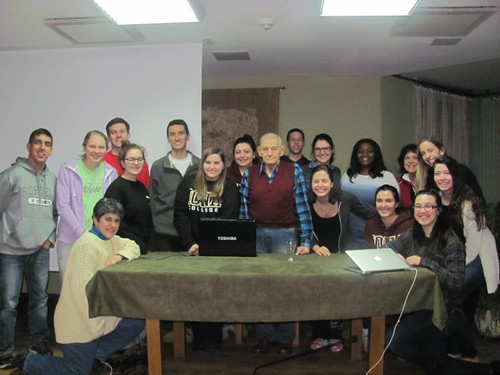
Later that day, when we returned to the Center for Dialogue and Prayer, we were blessed to have an audience with a survivor of Auschwitz II, Birkenau.  The survivor, Professor Długobroski, was a young member of the Polish Resistance Army in 1942, receiving military training through the underground organization.  With the help of a translator, the Professor shared his story with our group. 
Unfortunately, because of his involvement with the Hope Army, the Professor was arrested in May of 1943.  Professor Długobroski and his comrades sent to a flat of the Gestapo in Warsaw where they were able to hear shootings from the Warsaw Uprising.  On August 28, Professor Długobroski was transported to Auschwitz Birkenau along with approximately 1,500 other men.  He told us of his experience in the camp as a non-Jewish Pole. 

As I listened to the Porfessor’s story, I thought back to my trip to Birkenau earlier in the day.  Having visited the site, I was able to visualize the places he was referred to and imagine the scenarios he spoke about.  Unlike with the other survivors I had met, I was easily able to follow the events of his story.  As the Professor recalled his sleeping quarters, I could vividly picture the long rows of wooden bunk beds that I had seen that morning.  I was also able to mentally follow his path from Birkenau to Auschwitz I, as he struggled to carry heavy stones and gravel with his commando.  Although it was sad, it was extremely helpful to me to add this human perspective to the Birkenau camp since I had a hard time connecting to the site earlier. 


Personally, I think that Professor Długobroski’s account of his time in the camp allowed me to connect in a different way than I had previously done in Auschwitz I.  Without this personal description, it would have been much more difficult for me to feel as though I understood the human experience in the camp.  Furthermore, having a personal interaction with a survivor of the camp just after having experienced the camp for the first time added a whole other remarkable dimension to me, allowing me to associate with the history in a very deep and meaningful way.


-Joanna Ziegelbauer
Class of 2014