Tuesday, March 18, 2014

No Words. - Kara Pacewicz

Auschwitz I
I’ve been starring at a blank page for minutes on end now. The day I had today cannot be put into words; the emotions one feels when experiencing such a day are indescribable. Today started out as any other day. Woke up, had breakfast, packed my bags and took off. Who would have thought that today, just like any other day, would be the most life-changing day of my life?
Arbeit Macht Frei - Work Sets You Free
 When entering Auschwitz 1, thoughts, emotions, and sights filled my head. What I thought I was going to see, the emotions I thought I was going to feel were completely and utterly different. I remember sitting in the car with my father the day before the trip as he explained how powerful and heavy the material I am going to learn and see will, and he asked if I was ready. I explained to him that the Shoah, most commonly known as the Holocaust, is a sad and horrific event but I knew I could handle it, and I knew I was able to face it. I don’t think I have ever been so wrong in my life, what I thought I knew about the Holocaust, and what I thought I would feel, was the opposite. The emotions and sensations that filled my body was like someone light something inside of me. It felt as if I was hit with a ton of bricks, it felt like someone pulled me back as I walked into the barracks. As I looked up, and saw the words that were melded into the gated entrance, Arbeit Macht Frei, Work Sets You Free, shivers went up my spine. Gazing at this entrance made what I was about to see so completely real.
The Holocaust is an event in history that will forever be remembered, it’s an event that will always hold as much emotions as it did 75 years ago. Today, as I spent my morning in Auschwitz 1, I couldn’t believe my eyes and ears. We were blessed to have such a passionate tour guide. The tone, the look she gave as she told us facts and stories made the moment even more stimulating. We were given headsets so we could hear our guide through the camp; this helped more than I thought it would. I was able to block out everything around me and just focus on the moment. Agnieszka, our tour guide, took us through the camp, entering and leaving buildings.
There are a few moments I would like to touch upon and reflect upon.
A moment that became so real to me was when we saw the hair. The hair from all the prisoners was cut off and pilled almost as high as the ceiling along the entire room. Seeing human parts of those who suffered on the grounds I was walking on made the moment become realistic.
Another moment that touched me in a very powerful way was the piles of pots and pans, shoe cleaner, and make up. This all proves that those who were being deported to the concentration camps actually believed they were being deported into a better life, that work actually does set you free. They had no idea that their tomorrow brought death, horror, and torture. Seeing pictures of children and adults smiling with their suitcases as if they were as happy as could be was heartbreaking. Children are children, they are sweet and innocent, and no one deserved what happened to them during the war, especially the poor children.
The pots and pans from the prisoners.

A picture hanging in a barrack with smiling children.
Along with pots and pans, shoe cleaner, and make-up, there was also another room completely devoted to the shoes of the prisoners. One full room was all shoes, piles, and piles of shoes.  There were 80,000 shoes in that one room. These shoes were personal possessions that were on their very feet as they were told to strip naked and to strip of their identity. It was the last shoes many ever wore, and to be surrounded by that thought is a very overpowering feeling.
A tiny part of the room filled with the 80,000 shoes.
 There were two more moments during the last barrack that left me in a moment of awe. As we entered the second to last room in the last barrack for that day, I saw white walls with nothing in it. That’s when I noticed the small drawings done in pencil surrounding the room. They were at eye level for children, that’s when Agnieszka explained that each one of these drawings were replicas of children’s drawings during the war.  To see such depressing and scary drawings of people being shot at, hung, and carried on a stretcher, showed to me that these children actually understood what was going on in the camps. The fact that poor innocent children were forced to see and experience such horrific sights that adults shouldn’t even have to see or experience is beyond heartbreaking. Along with these shocking drawings, there were also sweet drawings that broke my heart just as much. Seeing drawings of birds, trees, flowers, and family’s, broke my heart because this also shows that even though the children were going through a horrible event and understood it in some ways they were still being children, they were still being positive and still being ignorant.

Replica of a child's drawing of people being hung

Replica of a child's drawing of a dead body being carried.
 Directly after this room, came the room with the names listed in alphabetical order. My family is from Poland, but we are not sure of what town or city. Seeing two Pacewicz’s who were killed in Poland really touched me deeply. Even though these two women are most likely not related to me, knowing that there is even a tiny minuscule percentage of a chance they could be family, made all the emotions I’ve felt through out the day hit me all together and in a harder and more powerful way.

In memory of Tzvia Pacewicz.

In memory of Brakha Pacewicz.

Today was the beginning of a journey that will forever be apart of my life and will forever have a place in my heart.

Cześć! Intro & Auschwitz I-Ashley Tigershtrom


"Arbeit Macht Frei" Gate at Auschwitz I


          Cześć! My name is Ashley Tigershtrom and I am a sophomore at Iona College majoring in Psychology. On Saturday, March 15th, we arrived in Oświęcim, Poland. After months of preparation and a 24 hour journey from the college campus to the Center for Prayer and Dialogue, we are finally here. Although we worked hard to become both intellectually and mentally prepared for this trip, it quickly became apparent that even with all the preparation in the world, you will never be one hundred percent ready for what you will experience here. 

          Prior to the trip, I had several concerns, along with many reasons for coming to Oświęcim. Coming from a Polish Jewish background with a lot of family history regarding The Shoah (also known as the Holocaust), I knew that this was something I had to do. As afraid and reluctant as I was, I saw it more of an obligation to honor my family, rather than a choice. Upon our arrival, I realized that this trip would be difficult in even more ways than I had imagined. However, having the support of incredible individuals has allowed me to push through thus far and to see the light in the darkness that surrounds us. 

          Today, March 17th, we had the first part of our tour of Auschwitz I, the most notorious concentration camp used to carry out Hitler's "Final Solution." Being there was very difficult, and in a way it was much more intense than I had expected. As the only things remaining are the buildings and the possessions from the prisoners, there is much left to your imagination. There, you must listen to the voice of the soil. The walls scream with history and are the only "witnesses" left behind at the camps, therefore you must be attentive to the stories your tour guide tells you and create the images in your mind and in your heart. Another important thing to keep in mind was that we were in not only a museum, but in a cemetery. Being the site of such a mass murder, as well as being the location where the ashes of many victims has been scattered, we were walking in the footsteps of death itself. 

          As we began to walk towards the gas chamber and the crematorium, I could not shake off the notion that we were freely walking in a place where others were forcibly confined to, walking towards a much different fate. It truly gave me goosebumps, but I could not ignore how lucky we are in comparison to others, just two generations before us. Being that my family members were Jewish Poles, there isn't a doubt in my mind that if they hadn't decided to flee Poland right before it was too late, I would not be here typing this post. And although my grandparents were lucky enough to escape, many of my relatives and the relatives of many others did not share that fate; the majority of Jewish families in that area ceased to exist after the Shoah. Having the opportunity to walk in these footsteps and honor my family and the family of so many others is truly life changing. I know for certain that we will all come home with a unique perspective and a new found knowledge, one that we have each felt in our hearts and souls in Oświęcim, Poland.


Questions- Joanna Ziegelbauer

Entrance Gate to Auschwitz I Camp

Why?  How?  What could have been done?  What should have been done?  Could this have been prevented?

Upon my arrival at the Center for Dialogue and Prayer in Oswiecim, I already had many questions floating around in my mind.  Some questions were very personal to me, relating to my own faith and personal understanding of the Holocaust, and others were regarding information I had not yet had a chance to acquire.  Most of these questions are still in my mind, and after visiting Auschwitz I for the first time, many more questions have developed for me. 

It is an incredible and indescribable experience to face a location developed for the destruction of human life, and to face the remains of an evilly twisted ideology.  Despite numerous lessons about the Holocaust taught over several years through various mediums, there was nothing that could have prepared me to walk through the Auschwitz I camp.

As we entered the site, there was an immediate feeling of the stillness in the air.  Everything that I had seen in pictures and films suddenly became real and felt overwhelmingly heavy.  I was filled with apprehension while approaching the gate with the infamous phrase, “Arbeit Macht Frei,” as shown in the image above.   For me, the iconic image of this gate always represented the complete and utter worst of humanity, and up until I reached the gate, it had always seemed worlds away. 

Thankfully, as our group walked through this gate and the camp grounds, we were led by an extremely knowledgeable and compassionate guide who was able to provide us with a comprehensive understanding of the events that had taken place.  Each exhibit that we witnessed was comprised of astounding facts and artifacts, telling a more horrendous story than I could have ever imaged. 

The most striking pieces I encountered centered on the experience of the child victims.  A particular picture of Hungarian Jews arriving at the camps stands out boldly in my mind.  In the bottom right corner of this picture stood a young child, no more than four years old.  The innocence of such a young age cannot easily be described, and yet this child was already condemned to death due to his family’s religious affiliations.  After seeing this picture, we encountered an exhibit containing belongings confiscated from victims upon their arrival to the camp.  One specific portion of this exhibit was displaying the shoes of children.  It is unthinkable to me that anyone would be able to harm a child, let alone thoughtlessly kill thousands.  So, because these images and exhibits struck me so greatly, they have also left me with much to think about. 


I came into this experience with questions I hoped to answer, but I am beginning to realize that some questions are only meant to inspire thinking, not necessarily to be answered.  Now, what I truly hope to gain are not answers, but experiences that I can share with those who have not been blessed with an opportunity to visit these sites themselves.

-Joanna Ziegelbauer
Class of 2014

Welcome to Poland. Kelly McGovern


March 16, 2014

Hello, my name is Kelly McGovern and I am a junior at Iona College studying Social Work. The main purpose for this blog is for me to share my experiences and feelings about my journey.

I decided to come on this trip to learn more about the Shoah, more commonly known as the Holocaust. I want to learn more by visiting different museums, galleries, speaking with historians and survivors as well as being able to visit the death camp Auschwitz. I also hope to gain knowledge about the culture and traditions in Poland.


Today was the first day we ventured out into the cities. We visited Wadowice, the town where Pope John Paul II grew up. It was extremely interesting to see actual pictures and pieces of furniture that were in the Popes house. I learned many things about Pope John Paul II that I was not aware of such as his real name, Karol Wojtyła. Learning that the Pope loved to ski, play sports, act in plays as well as write his own plays was almost comforting. 


Pope John Paul II with his bassinet


Pope John Paul II skis 

After visiting the exhibit on Pope John Paul II, we attended a Polish Catholic mass. Although the whole mass was in Polish, I was still able to understand what was going on to a certain point from the gestures of the priest and parishioners, as well as the tone of the songs that were sung. Before the mass began, we were given a sheet of paper, which had the English translation of the scriptures and Psalms that were being read. The fact that I was able to understand what was happening almost put me in awe. It truly shows how consistent the Catholic religion is worldwide. 


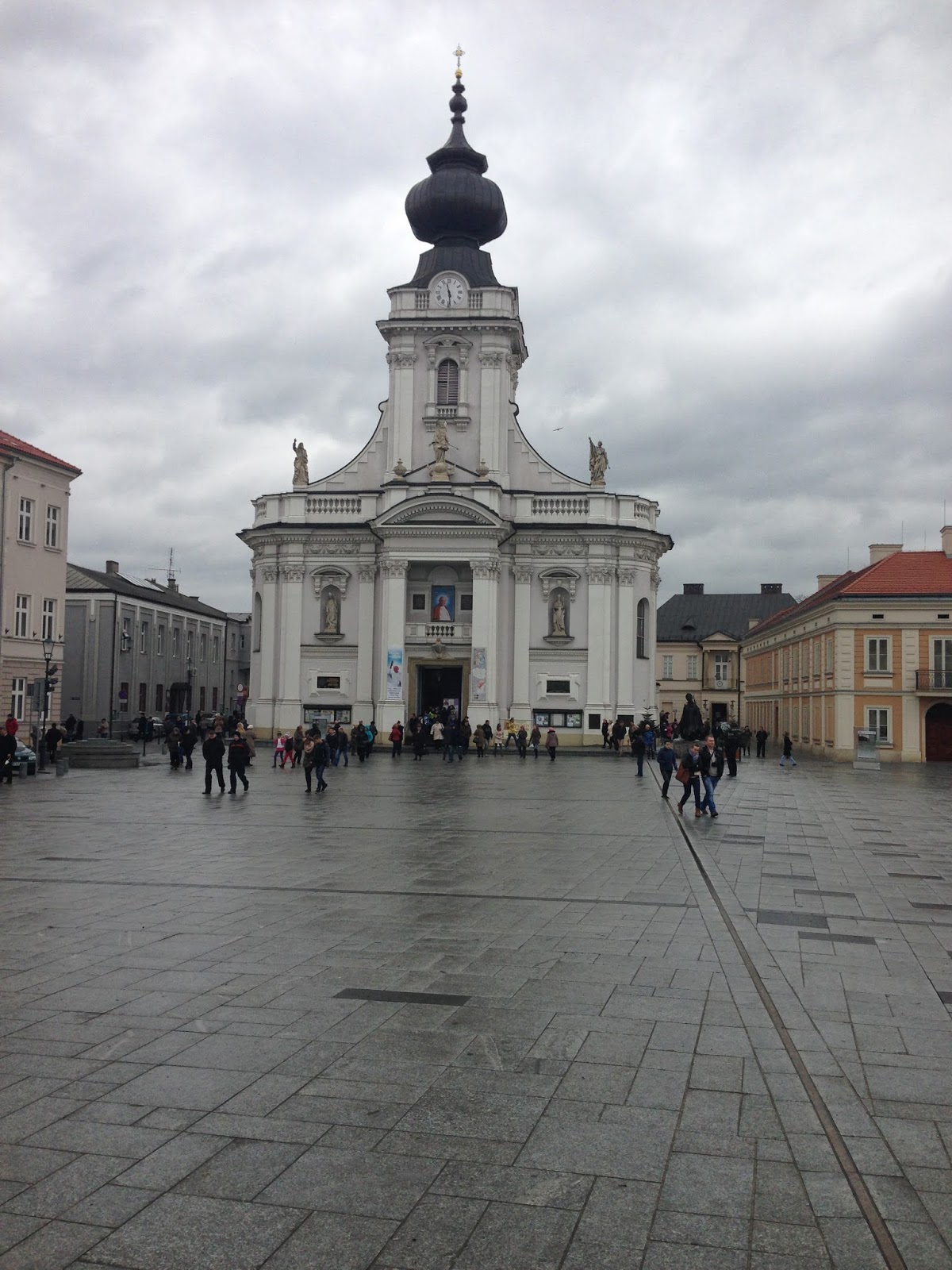
Church where I attended mass 


Oświęcim was the second town we visited. First, went to a Jewish center, which housed the last standing synagogue in Oświęcim. The first room we went into was the synagogue. All of the furniture was replicated, because when the Nazis overtook this particular synagogue, they burned everything that was inside. There were two plaques on the wall, which indicated advisors of the synagogue, as well as a memorial from a wife to a husband of the synagogue. Having only been to a synagogue once, it was fascinating to learn about everything in the synagogue and its meaning. My favorite was being able to see where the Torah was kept and how it is read. The covering over the Torah was beautiful. 


Cabinet with the Torah's inside 


The second room we went into in the museum contained different artifacts and pictures of those who lived in Oświęcim. I love to see the pictures of people doing daily activates. It helped me better visualize how life was during that time. There was one box, which contained artifacts that were in the Great Synagogue, which was torn down by the Nazis. There was a beautiful menorah and a chandelier. The chandelier had an eagle at the top, which I later learned, is a national symbol for Poland. 


Artifacts from the Great Synagogue 


Seeing these artifacts that were once apart of such an amazing structure that no longer exists, and seeing pictures of those innocent people who lived in Oświęcim who were persecuted for no real reason was upsetting. When our tour guide for this museum was explaining the different pictures to us, she stated how for almost every picture the fate of those who were photographed is unknown. After hearing this, it made me mentally prepare myself for what the rest of the trip has in store for me.


I am so thankful and blessed to be able to be apart of such a life changing and meaningful trip.

Dziękuje!

Kelly McGovern 


Was God Present in Auschwitz? - Jackie Martinez

Entrance to Auschwitz I

I had been anticipating this day for months, the day where I'd stand on the same grounds where over 1.1 million people, 90% Jewish, were killed.  When I awoke this morning, I realized the day was here and to be honest, I had no idea what to expect anymore. As our group walked over to Auschwitz I, I figured that the dreary and cloudy weather would reflect the solemnity of our tour, and I was right. Everything I witnessed today was eye-opening. We learn about this tragedy in school 4000 miles away about 75 years later, but to be present on the camp's grounds gives one an entirely clearer perspective on the events that occurred here. Going through today's tour of Auschwitz I, I began to reflect on one of my questions I posed for myself in yesterday's post. However, instead of asking "Why would God let His people suffer this greatly?" I have amended it so as to ask, "Was God present in Auschwitz?"

Panorama Image of the Barracks in Auschwitz I


I've always believed that God is omnipresent and that no matter how much one may be struggling, He is still there beside that person guiding them through that struggle. However, today for the first time I questioned if God was actually there watching over His people as they were starved, tortured, killed, and most of all, dehumanized. There were many instances today when that question came up in my mind. It's hard to imagine how vast a number like 1.1 million is until it is put into perspective in some way. During our tour, our guide, Agnieszka, asked us approximately how many students go to Iona. Around 3000, we told her. With that number, she told us that all of Iona would have been placed in three barracks. That was a shock, as each barrack looked like it could hold at most 300 people. But 1000 people to one barrack? How easy it must have been for the prisoners' health to deteriorate in these conditions, in addition to the lack of sufficient food and excruciatingly excessive amounts of hard labor they had to endure. Furthermore, my question of God's presence at the camps came up again when we saw the clothes of the young children who were killed there. How could God have been present when these innocent children who did nothing wrong were killed? Finally and most importantly, was God present in the gas chamber? No one will ever know what happened in the thirty minutes it took for the Jews to suffocate and eventually die in the chamber due to the poisonous gas that stripped the room of all oxygen. To have been standing in the chamber today where hundreds were crammed in the darkness previously expecting to be receiving a shower after their several days of traveling without food or shower and now knowing that they were about to be killed had a profound impact on me. Here was when I truly began to reflect on God's presence at not just Auschwitz but all of Poland and on everyone who suffered during the Shoah. 


In the middle of the gas chamber today, there was a vase filled with white and red flowers and two candles on either side of the vase. Although I was saddened by everything I had seen, the vase filled me with a sense of hope and renewed my belief in God's presence everywhere. Yes, millions suffered and died during the Shoah but God's presence was active in those who never wavered in their belief in Him and those who performed acts that saved the lives of others, sometimes even at the cost of their own lives. For example, we saw the starvation cell in which Maximilian Kolbe stayed for 14 days until the guards finally killed him. He was a Catholic priest who sacrificed his own life in order to save the life of another. God was present in him. Although this did not take place in Auschwitz, we see God's presence in Lena and Alexander in the book, "The Holocaust Kingdom," when they say goodbye to their son, Wlodek, in order to secure his safety. For parents to have to sacrifice their own right to watch their children grow up in order for their child to have the basic right to grow up is God's presence within them. Mothers who went with their children to the gas chamber instead of abandoning their children to save themselves had God within them, thus making God present in the camps. Countless were lost, but think of how many more could have been lost had it not been for those who put the lives of others ahead of their own. It is in this way that God made Himself present in the camps and, through these acts of sacrifice, provided hope for those who were still surviving.

Witamy w Polsce! (Welcome to Poland!) - Jackie Martinez

Basilica of Our Lady, Wadowice
Hello, my name is Jackie Martinez and I am a current sophomore at Iona College majoring in chemistry.  I figured I'd begin my first blog post by writing about my current excitement/nervousness about being here in Poland. Today has been filled with excitement, particularly because I visited Wadowice, the birthplace of Pope John Paul II. I think the highlight of today's experience for me was going to a Polish mass in the same church where the pope received his sacraments.  During the mass, since I was unable to understand the pastor's homily, I began to reflect on the church I was in. I was sitting in a seat that at one point the pope himself might have sat in during the course of his childhood. I walked in the same line he always walked as a child and young adult to receive the Eucharist. It left me in awe, to say the least. Later on that evening, we heard a lecture from Father Manfred that reminded me just how serious this trip is. Not to say that we can't have fun while we're here, we just have to be mindful of the events that occurred here about 75 years ago. Regardless, I still have become a bit apprehensive for what we will become witnesses to in the upcoming week.

To help me handle this feeling of apprehension, over the past few days using what I have read and learned about thus far, I have created several questions that I hope to have answers to by the end of the week and hope to give my own explanations for in future blog posts.  First, the major question I think everyone studying the Shoah, the religious name for the Holocaust, wants answered, including myself, is why? Why would God let his people suffer this way? Another question I want to reflect on is "what if it was me?"  Would my faith waver or would I still maintain my belief in God if I were ever in a situation like this? I have some idea now for my answer but before I give a full answer for it, I want to experience all of this trip first in case my answer changes or develops further. Finally, in tonight's lecture by Father Manfred, a good portion of what was discussed centered around trust and healing. However what I've been pondering isn't so much of a question as much as it is a reflection. How can what we've learned in his lecture be applied in our everyday lives?

There is so much left to be answered; there may not even be answers for some of the many more questions I have. My biggest expectation however is that I leave Poland with a religious understanding of the Shoah and maybe even with a new outlook on life in general.

Monday, March 17, 2014

Cześć! - Kara Pacewicz

First selfie in Poland!

My name is Kara Pacewicz and I am junior at Iona College. I am studying Sociology and Criminal Justice. Coming from a Polish background and an interest in the Holocaust I am excited and am enthralled to be here in Poland. There are many things I am looking to get out of this trip. Honestly, the main reason I signed up for this course was because of the opportunity to study aboard in a place I probably wont get the chance to visit again. As the weeks went on and the trip was approaching I started looking at the bigger picture. The reason why I was being brought to Poland is due to the horrific event: the Shoah, or most commonly known as the Holocaust. To think that is the reason I was brought to Poland, and to be so excited to be here, is due to the Shoah, is hard to comprehend and understand. As I am studying here I hope to gain more information and more of an understanding to what truly occurred here, along with how God let this happen, the history behind Poland, and the knowledge of where I am from.

Today was the first day, March 16th. As a group we traveled to Wadowice, we spent the morning in an exhibit based on Pope John II. There we saw Pope John’s belongings that were able to help give us a feel for the type of person he truly was. After this we attended mass at a Roman Catholic Church. Seeing the Church and how beautiful the coloring and architecture inside was, made me realize how serious religion is to this area. It made me wish that the churches around me were like this too. I was able to understand most of what was going on during the mass because of the gestures and sayings the attendees said back. Receiving communion in the old fashion way, by opening your mouth and sticking your tongue out, was a very great experience. With being Catholic, attending mass here was an experience I will always remember.

Me in front of the Church we attended mass!
After mass we drove to a Jewish cemetery, which was very interesting to see. The gravestones, and the writing on the gravestones were remarkable. Being here really made me think about the lives that were lost in the area I was living in for the next week, and that most of those lives did not have the chance to be buried.
Two gravestones at the Jewish Cemetery! 

After this interesting experience, we drove to another museum, where a guide awaited to explain the Synagogue, and the other pieces and pictures inside. It was intriguing. It was the last Synagogue standing in Auschwitz during the time of the war, we also learned that the Germans kept ammunition inside, knowing we were sitting in the place where the German kept their ammunition was a feeling indescribable. It became so real.

            Tonight, we had a lecture from Father Manford. His lecture was one of most interesting lectures I’ve heard. He was very informational and insightful. One question I have been wondering about since this class started is, why and how did God let this happen? Father Manford explained that we will be having another lecture fully based on this topic, which I am more than excited and anxious about.


            All in all my first day here was more than I hoped. It really gave a feel for the rest of the week and what more I will be seeing and experiencing. The people who work at the center along with those we met during our journey here are all so welcoming and pleasurable. I learned the translation to the word, thank you, hearing the language showed me that I really want to learn the Polish language. The only negative about day one is that it is one more day closer to a trip of a life time to end.